
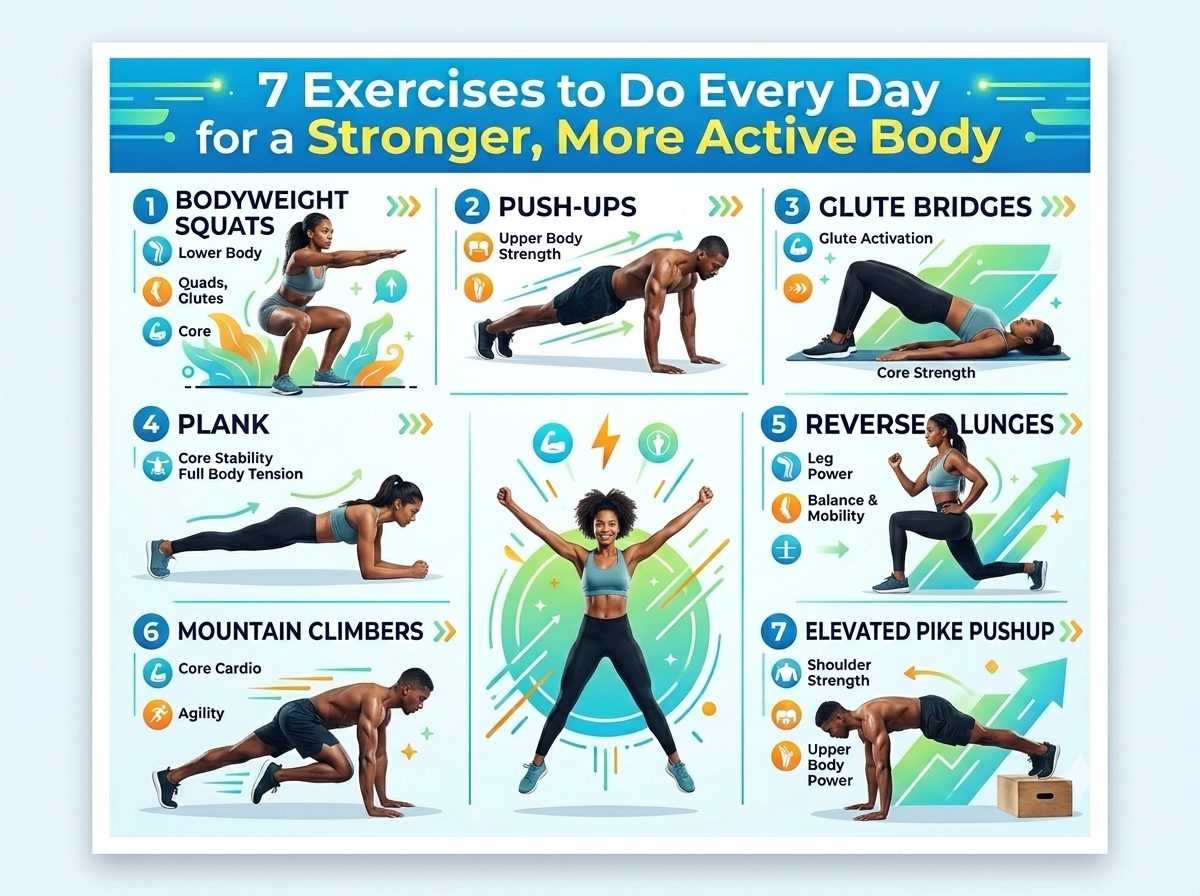
7 Exercises to Do Every Day for a Stronger, More Active Body
Finding the right workout does not have to mean joining an expensive gym, buying a room full of equipment, or spending an hour every day following a complicated program. For many people, the biggest challenge is simply knowing which exercises to do consistently. A practical routine built around bodyweight movements can give beginners a simple starting point while also leaving room to progress. If you are searching for 7 exercises to do everyday, exercises you can do while practicing at home, or a straightforward beginner routine, the goal should be consistency rather than perfection.
The Centers for Disease Control & Prevention recommends that adults get at least 150 minutes of moderate–intensity physical activity each week along with muscle strengthening activity on at least two days. That does not mean you need to perform a hard workout every single day. Instead, think of daily movement as building a habit, while your weekly routine provides the bigger picture. The seven exercises below cover several major movement patterns, including squatting, pushing, lunging, core stabilization, hip extension,& shoulder focused pressing.
Why a Simple Daily Workout Can Make a Difference
A workout becomes much easier to maintain when it fits naturally into your day. Imagine exercise as brushing your teeth: you do not need to negotiate with yourself every morning about whether the activity is worth doing. A short, familiar routine removes some of that decision making. For someone who spends much of the day sitting at a desk, even adding regular movement breaks, walking, mobility work, & short strength sessions can be a meaningful step toward becoming more active.
The current U.S. physical activity guidance emphasizes that some physical activity is better than none. Beginners can start with manageable amounts & gradually build their activity over time. This is especially useful because an intimidating workout can quickly become something you avoid. Your first goal is not to exhaust yourself. It is to create a routine that you can repeat, understand, & gradually improve.
How Much Exercise Do Adults Actually Need?
For adults, current physical activity guidance recommends a combination of aerobic activity & muscle strengthening work. The CDC recommends at least 150 minutes of moderate intensity aerobic activity each week & muscle strengthening activities on at least two days per week.
That means the phrase 7 exercises to do everyday should not be interpreted as seven hard workouts every day. Instead, these exercises can become part of a broader weekly routine that includes walking, cycling, recreational activities, mobility work, & recovery.
7 Exercises to Do Every Day at Home
The following seven exercises provide a practical collection of movements that can be performed at home with little or no equipment. They can be modified for beginners & progressed as your strength improves.
1. Bodyweight Squats
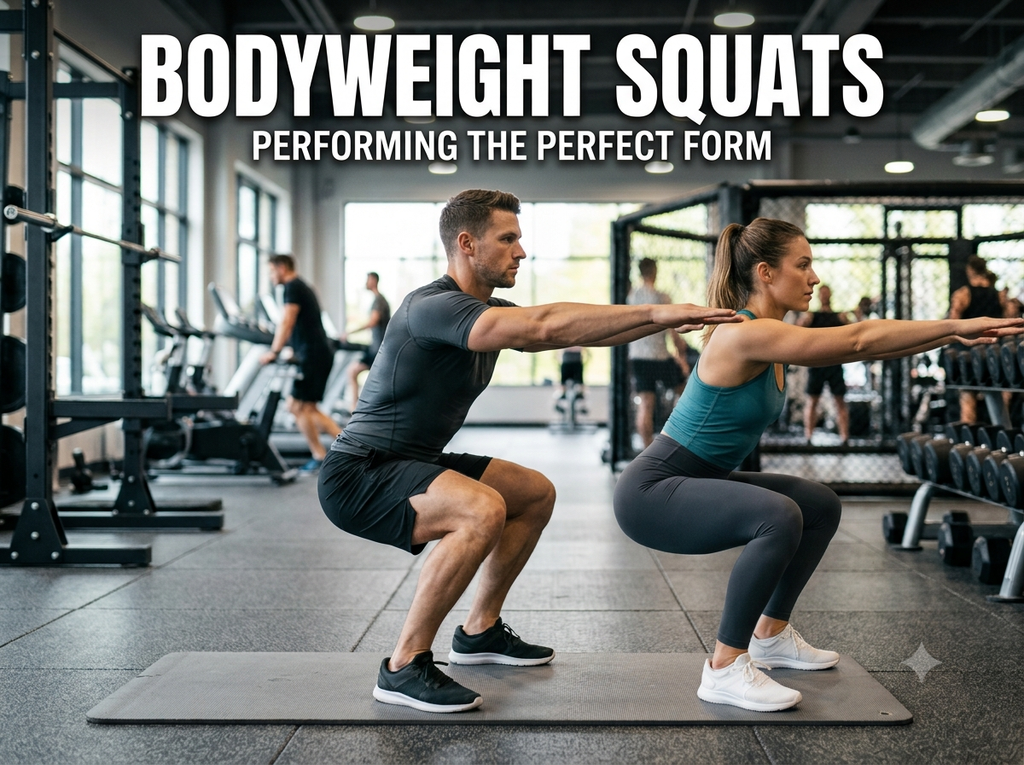
The bodyweight squat is one of the most useful exercises for beginners because it trains a movement pattern you already use in everyday life: lowering your body & standing back up. It primarily challenges the muscles of the lower body, including the quadriceps & glutes, while also asking your trunk to stabilize your body. Stand with your feet around shoulder width apart or in a stance that feels comfortable. Keep your chest reasonably upright, brace your midsection, bend your knees & hips, & lower yourself only as far as you can control comfortably.
Then press through your feet & return to standing. You do not need to force yourself into an extremely deep squat to make the exercise useful. Beginners can start with around 8-12 controlled repetitions for one or two sets. If balance is an issue, perform the movement near a sturdy support or use a chair as a target for your hips.
2. Push-Ups
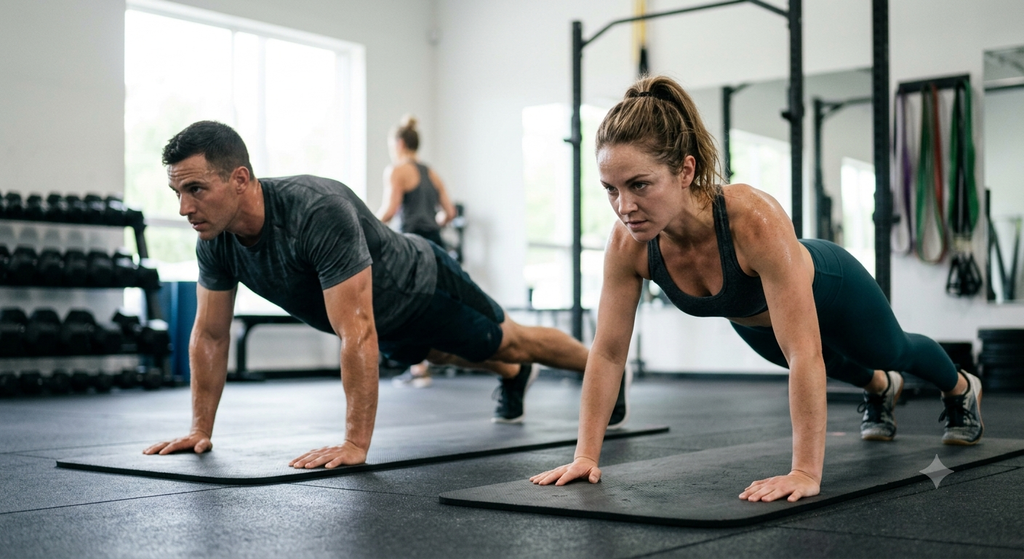
Push-ups are a classic upper-body exercise because they combine pushing strength with core control. A traditional push-up begins in a high plank position with your hands on the floor. Keep your body relatively straight as you bend your elbows & lower your chest toward the floor, then press the floor away to return to the starting position.
Beginners do not need to start with a full floor push–up. You can use a wall, countertop, sturdy elevated surface, or knees-on-the-floor variation to reduce the difficulty. The important part is choosing a version that allows you to maintain controlled technique.
3. Glute Bridges
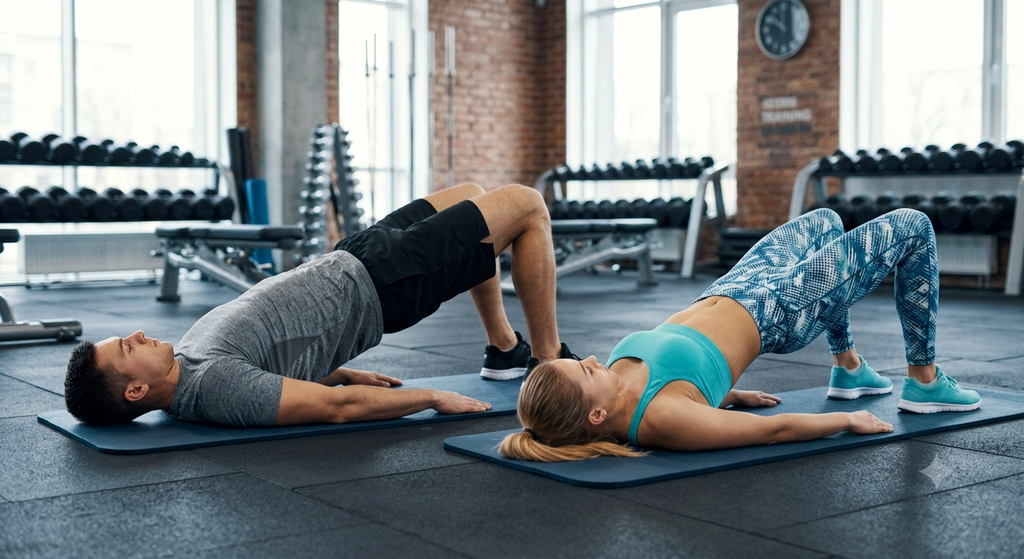
Glute bridges are a simple ground workout option that targets the muscles around the hips & posterior chain while keeping the movement relatively low impact. Start by lying on your back with your knees bent & your feet resting on the floor. Brace your midsection gently & press through your feet to lift your hips.
Pause briefly near the top while squeezing your glutes, then lower your hips with control. The movement should come from your hips rather than from aggressively arching your lower back. Start with around 10-15 repetitions & focus on controlled movement.
4. Plank
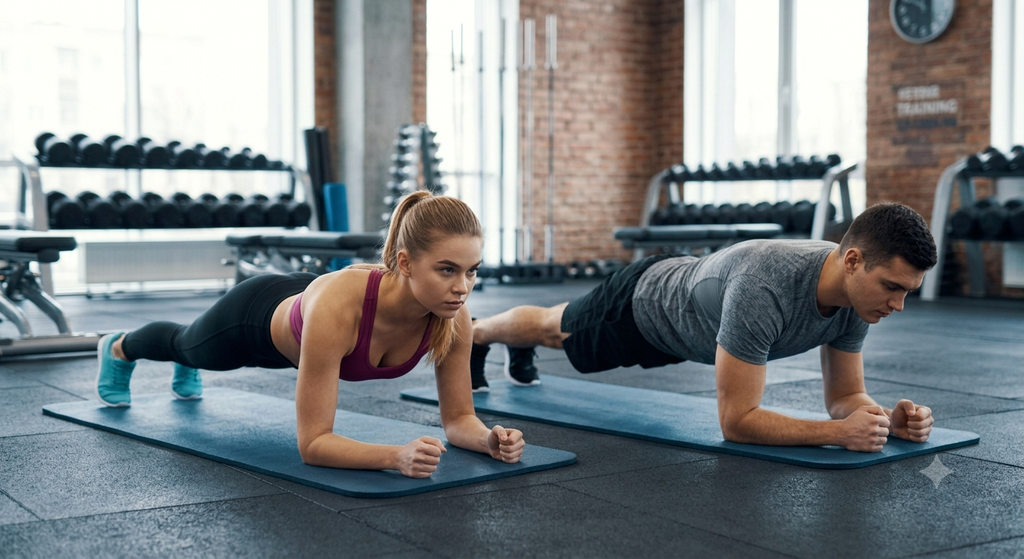
The plank is less about moving quickly & more about resisting unwanted movement. That makes it useful for practicing trunk stability. Begin with your forearms or hands on the floor & your legs extended behind you, depending on the variation.
Beginners often make the mistake of treating the plank as a contest to see who can stay up the longest. That is not necessary. A shorter hold with good positioning can be more useful than a very long hold performed while the hips sag or the shoulders become uncomfortable.
5. Reverse Lunges
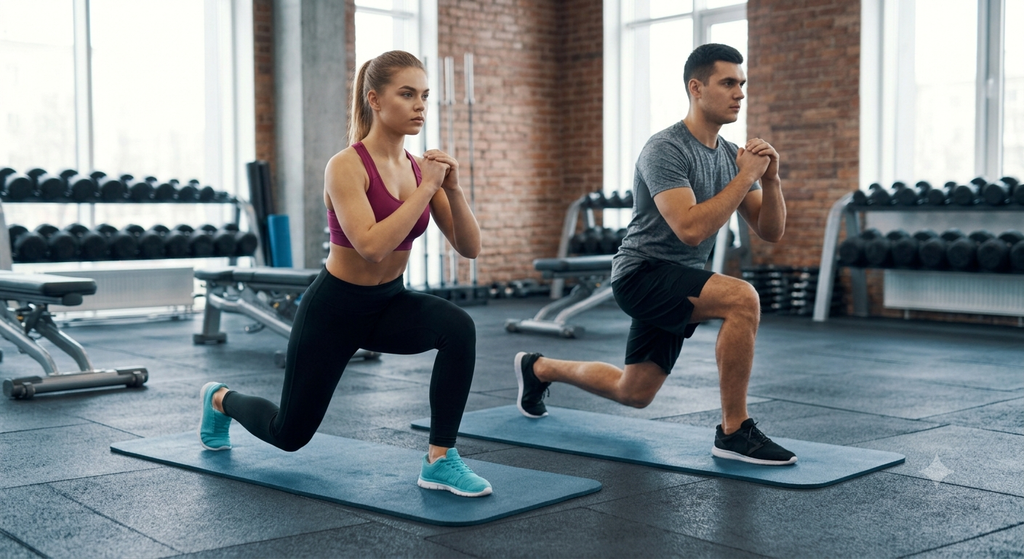
Reverse lunges bring a single–leg element into your workout & can challenge balance, coordination, & lower body strength. From a standing position, step one foot backward, lower your body under control, & then push through your front foot to return to standing.
Beginners should focus first on balance & control. If stepping backward feels unstable, hold onto a sturdy support or reduce the depth of the movement. You can also perform a stationary split squat before progressing to a full reverse lunge.
6. Mountain Climbers
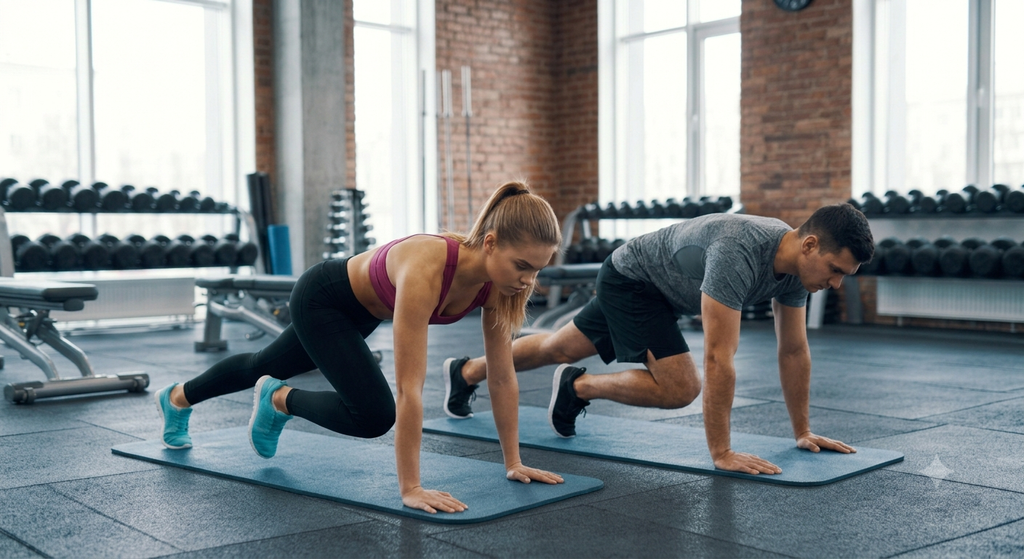
Mountain climbers add a more dynamic element to this list & can raise your heart rate while challenging your core & upper–body stability. Start in a high–plank position, then bring one knee toward your chest before returning it & switching sides.
You can perform the movement slowly for greater control or increase the pace once you are comfortable with the basic pattern. Beginners should not feel pressured to sprint through the exercise. A slower version can help you learn how to coordinate your legs while maintaining a stable upper body.
7. Elevated Pike Pushup
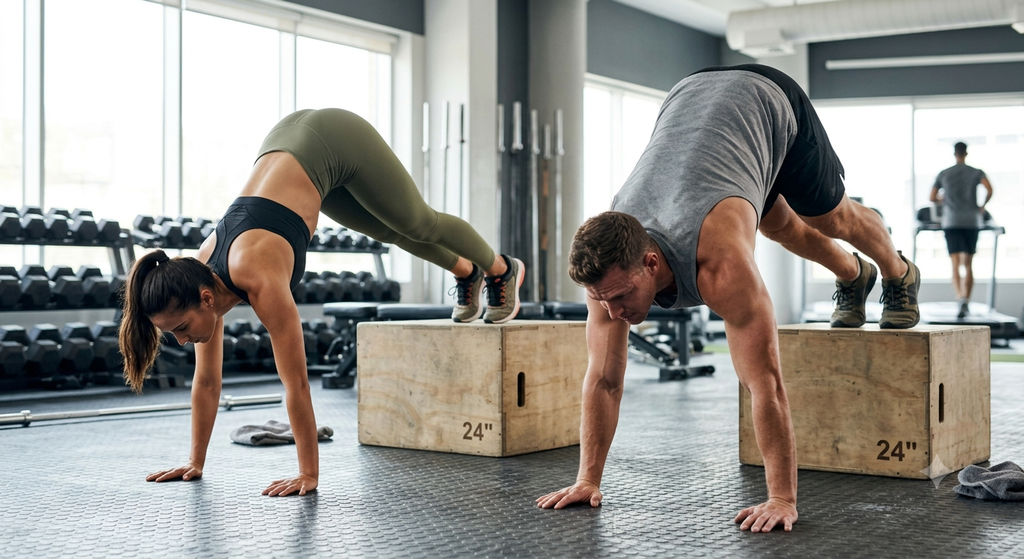
The elevated pike pushup is the most advanced movement in this seven–exercise list & should be approached gradually. It shifts more emphasis toward the shoulders & upper body than a standard push–up, which is why beginners should first become comfortable with easier pressing variations.
In a pike position, your hips are raised while your hands remain planted on the floor, creating an inverted–V–like shape. You then bend your elbows & lower your head & upper body toward the floor before pressing back up. Elevating your feet makes the movement more demanding, so it should not be your first choice if you are new to strength training.
Start with a regular pike push–up or another easier variation & focus on controlled repetitions. When your technique is consistent, you can explore progression gradually. The elevated version can become a useful exercise for someone who wants a stronger challenge without immediately moving to a handstand push–up.
How to Build a Beginner Workout at Home
A good beginner workout does not need to contain every exercise you know. In fact, throwing dozens of movements into one session can make your routine harder to follow & harder to progress.
Start by selecting movements that cover different patterns: one lower–body squat, one upper–body push, one hip–focused exercise, one core movement, & one conditioning exercise. The seven exercises above give you enough variety to create several combinations without needing gym equipment.
For example, a beginner could perform:
| Exercise | Beginner Starting Point |
| Bodyweight squats | 8–12 reps |
| Incline or modified push–ups | 6–10 reps |
| Glute bridges | 10–15 reps |
| Reverse lunges | 6–10 per leg |
| Plank | 10–30 seconds |
| Mountain climbers | 15–30 seconds |
| Elevated pike pushup | Practice easier variation first |
Give yourself enough rest to maintain good technique. If you are completely new to exercise, one round may be plenty at first. After a few sessions, you can add another round or increase the repetitions.
Total Gym Workouts for Beginners
The phrase total gym workouts for beginners can refer to full–body training rather than a particular piece of equipment. A total–body workout simply means you train several major muscle groups during the same session.
You could combine bodyweight squats for the legs, push–ups for pushing muscles, glute bridges for the hips, planks for trunk stability, & mountain climbers for conditioning. If you own resistance bands, dumbbells, or another appropriate training tool, those can be added later.
Fun Workouts at Home to Keep Exercise Interesting
Exercise becomes much easier to maintain when it is something you genuinely enjoy. That is why fun workouts at home deserve a place alongside traditional strength routines.
You can turn a simple session into a mini circuit, play music while you exercise, follow a dance–based routine, walk around your neighborhood afterward, or challenge yourself to learn a new movement over several weeks.
Variety can also help prevent boredom. One day might emphasize strength, another might focus on mobility & easy cardio, & another could be a short bodyweight circuit.
The goal is not to turn every session into entertainment. It is to remove the idea that exercise must always feel like punishment.
Ground Workout Ideas for Small Spaces
A ground workout can be ideal when you have limited space & no equipment. Exercises such as glute bridges, planks, modified push–ups, bird dogs, dead bugs,& floor–based mobility drills can all be performed on a relatively small area.
This makes them convenient for apartments, bedrooms, home offices, or other spaces where jumping & running are impractical. A mat can make floor exercises more comfortable, particularly on hard surfaces.
Exercises That Start With N, E,and O
If you are creating exercise content, a workout challenge, a fitness game, or simply searching for names of exercises, alphabet–based categories can be a fun way to discover movements.
They can also help you avoid doing the same five exercises repeatedly. However, the first letter of an exercise name should never be the main factor determining whether it belongs in your workout.
Exercises Beginning With N
There are several useful exercises beginning with N, although the letter N has fewer common exercise names than letters such as S or B.
Nordic hamstring curls are one well–known example, but they are demanding & generally require a secure setup or appropriate assistance. They should not be treated as a casual beginner movement simply because they appear on an alphabet list.
When looking for exercises beginning with N, focus less on collecting dozens of names & more on understanding what each movement trains.
Exercises Beginning With E
When searching for exercises beginning with E, you will find names such as elevated push–up, elevated pike pushup, & eccentric push–up.
The elevated pike pushup is particularly relevant because it provides a more demanding shoulder–focused progression. An elevated push–up, by comparison, can make a standard push–up easier when your hands are placed on a stable raised surface.
Exercises That Start With O
Finding exercises that start with O can be more challenging because fewer mainstream exercise names begin with this letter.
You may come across movements such as overhead press & overhead squat. However, these should not automatically be considered beginner exercises simply because they fit an alphabetical keyword.
How to Create a Random Workout Without Losing Structure
A random workout sounds completely unplanned, but there is a better way to use randomness without creating a chaotic session.
Instead of randomly choosing any exercise that comes to mind, create several categories first:
- Lower body
- Upper body
- Core
- Cardio
- Mobility
Then select one movement from each category. This gives you variety while preserving balance.
For example, you might randomly choose squats from the lower–body category, an incline push–up from the upper–body category, a plank for core work, marching mountain climbers for conditioning,& a short mobility sequence to finish.
Randomness can be motivating, but complete unpredictability can make progress difficult to measure. If you never repeat an exercise, you cannot easily tell whether your strength or technique has improved.
A Simple Weekly Exercise Rotation
A weekly rotation can make your daily movement habit more sustainable. Monday could be a full–body strength session, Tuesday could be easier with walking & mobility work, Wednesday could return to strength,& Thursday could emphasize light cardio or a ground workout.
Friday could include another full–body session, Saturday could be a fun workout at home,& Sunday could focus on easy movement or recovery.
Current U.S. guidance supports combining aerobic activity with muscle–strengthening activity throughout the week rather than treating every day as a hard workout.
Common Mistakes Beginners Should Avoid
One of the biggest beginner mistakes is believing that soreness is the same thing as progress. A workout can be effective without leaving you unable to walk comfortably the next day.
Another common problem is increasing volume or difficulty too quickly. If you suddenly go from almost no exercise to performing hundreds of repetitions every day, your body may not have enough time to adapt.
Technique is another major consideration. A movement performed slowly & within a comfortable range can teach you much more than a rushed repetition performed simply to reach a target number.
Beginners should also avoid comparing their starting point with someone else’s years of training. Social media often shows the final result without showing the months or years of practice behind it.
Frequently Asked Questions
Can I do these 7 exercises every day?
You can use these movements as a daily movement menu, but that does not mean every person should perform all seven at high intensity every day. Strength training creates a training stimulus that your body needs time to recover from, so alternating harder & easier sessions can make more sense than repeating a demanding circuit seven days a week.
What is the best exercise to start with at home?
There is no single best exercise for every beginner. Bodyweight squats, elevated push–ups, glute bridges,& modified planks are practical starting options because they are easy to scale.
Are home workouts effective for beginners?
Yes. A beginner can build strength, movement skill, & general fitness using bodyweight exercises & other simple forms of physical activity at home. You can perform squats, push–ups, lunges, bridges, planks, & conditioning movements without a traditional gym setup.
How long should a beginner workout last?
There is no universal duration that every beginner needs. A short session can be useful, especially if it helps someone who has been inactive establish a regular habit. The CDC emphasizes that physical activity can be accumulated in manageable amounts.
What if I cannot do regular push–ups or lunges yet?
That is completely fine. Exercise variations exist so people can adjust a movement to their current strength & coordination. Instead of floor push–ups, try wall push–ups or elevated push–ups using a stable surface.
Conclusion
A useful exercise routine does not need to be complicated. These 7 exercises to do everyday provide a practical collection of movements you can use when practicing at home, especially if you are just beginning.
Bodyweight squats, push–ups, glute bridges, planks, reverse lunges, mountain climbers,& the elevated pike pushup cover several different movement patterns & can be modified as your fitness changes.
The key is not to perform every exercise as hard as possible every day. Instead, build a weekly routine that combines strength, aerobic activity, easier movement,& recovery.
Whether you are searching for exercises beginning with N, exercises beginning with E, or exercises that start with O, remember that the name of an exercise matters less than whether it is appropriate for your goals & ability.
Start where you are, progress gradually,& make consistency the foundation of your fitness journey.
