
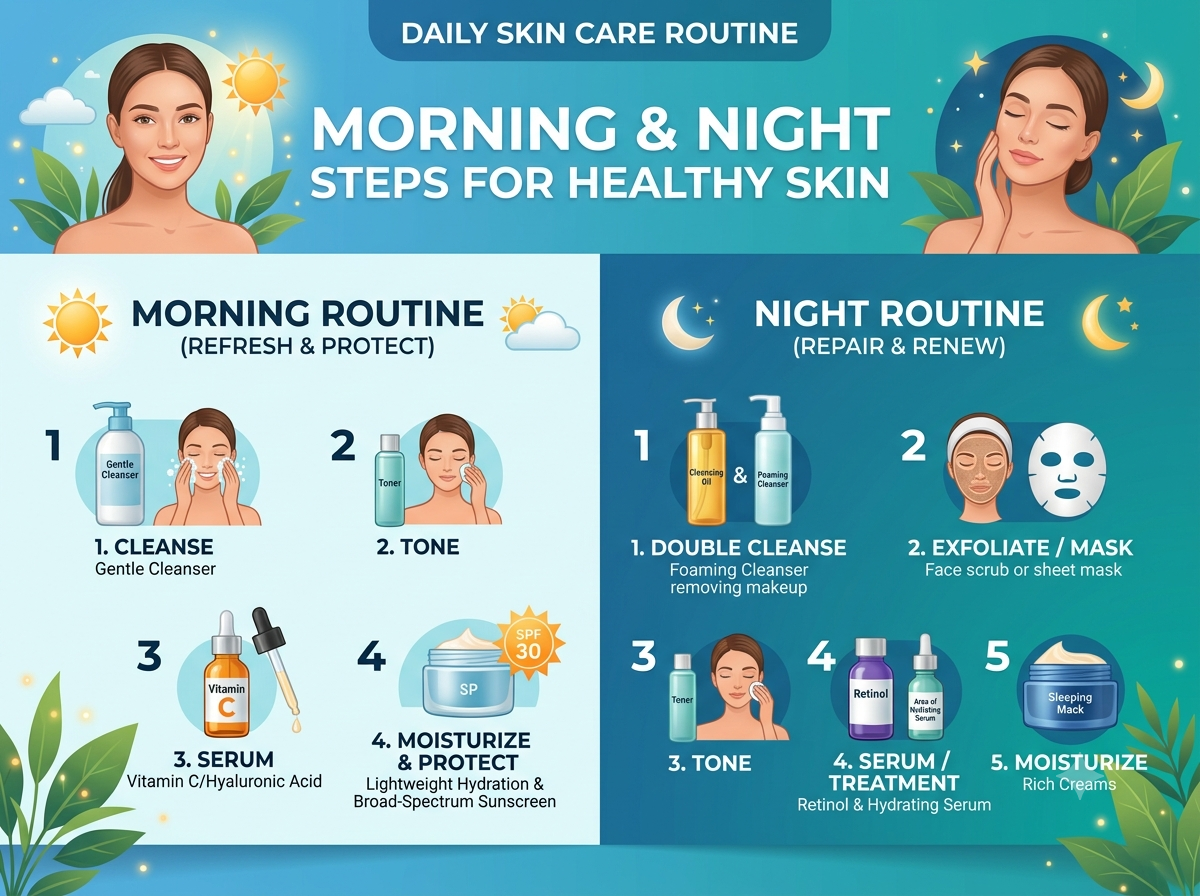
A good skincare routine does not need to involve a bathroom counter covered with dozens of products. For most people, the foundation is much simpler: cleanse your skin, use a treatment if you need one, moisturize and protect your skin from the sun during the day. The tricky part is knowing which products you actually need, what order to apply them in and how to adjust your routine for dry, oily, combination, sensitive or acne prone skin.
If you have ever searched for the best skin care routine, you are probably familiar with conflicting advice. One person says you need five serums. Another says you should exfoliate every day. Someone else recommends skipping moisturizer if you have oily skin. Then there is the classic question: serum first or moisturizer?
The reality is much less complicated.
The best routine is one that matches your skin’s needs and that you can follow consistently. The American Academy of Dermatology (AAD) recommends a relatively simple approach built around gentle cleansing, appropriate treatment, moisturizer, & sun protection. It also cautions that using too many products can irritate your skin.
For readers in the United States, daily sun protection deserves particular attention. The U.S. Food and Drug Administration (FDA) explains that SPF primarily indicates protection against UVB radiation, while a broad-spectrum sunscreen provides protection against both UVA & UVB radiation.
So, whether you are starting from scratch or trying to simplify a complicated routine, this guide walks you through the skin care routine order morning and night, product layering, skin type adjustments, makeup preparation, acne prone skin & common mistakes.
What Is a Good Skin Care Routine?
A good skincare routine is a consistent series of products & habits designed to cleanse, treat, moisturize and protect your skin.
For most people, a basic routine looks like this:
Morning: Cleanser → Treatment/Serum → Moisturizer → Sunscreen → Makeup
Night: Cleanser → Treatment/Serum → Moisturizer
You do not need every step every day. Your exact routine depends on your skin type, concerns, lifestyle, climate and the products or medications you use.
The AAD recommends applying skincare products in a logical sequence: cleanse first, apply medication or treatment next, then moisturizer and/or sunscreen, followed by makeup if desired.
That’s an important point because skincare isn’t a competition to see who can use the most products. In fact, adding too many products can increase the chance of irritation.
The Four Foundations of Skin Care
Think of your routine as a house. The cleanser, treatment, moisturizer, and sunscreen are the foundation. Optional products are additions you can make once that foundation is working.
- Cleanser: Removes dirt, excess oil, makeup and other buildup.
- Treatment: Targets a specific concern, such as acne or signs of aging.
- Moisturizer: Helps maintain hydration and support the skin barrier.
- Sunscreen: Helps protect exposed skin from UV radiation during the day.
If your routine already covers those basics, you don’t need to feel pressured to add another product simply because it is trending online.
How to Start a Skincare Routine
If you’re wondering how to start a skincare routine, start with fewer products rather than more.
A beginner can usually build a basic routine around a gentle cleanser, moisturizer and broad spectrum sunscreen. Once those products are comfortable and your routine is consistent, you can consider adding a targeted treatment based on your specific concern.
The AAD emphasizes that consistency matters and that a simple routine can provide a strong foundation for healthy skin.
This gradual approach has another advantage: you can tell what your skin actually likes. If you introduce five new products simultaneously & develop redness or irritation, figuring out which product caused the reaction becomes much harder.
Start With Your Skin Type
Before buying products, consider how your skin behaves.
Dry skin may feel tight, rough, flaky, or uncomfortable after cleansing.
Oily skin tends to develop excess shine, particularly around the forehead, nose and chin.
Combination skin may be oily in some areas and dry or normal in others.
Sensitive skin may react easily with burning, stinging, redness, or irritation.
Acne-prone skin tends to develop blackheads, whiteheads, pimples or deeper breakouts.
Your skin type isn’t necessarily permanent. Weather, hormones, medications, age, stress and your current skincare products can all affect how your skin behaves.
Skin Care Routine Order Morning & Night
The skin care routine order morning & night is easier to remember than it sounds.
The basic rule is:
Clean → Treat → Moisturize → Protect
At night, remove the protection step because sunscreen isn’t needed while you’re sleeping.
| Step | Morning | Night |
| 1 | Cleanser | Cleanser |
| 2 | Treatment or serum | Treatment or serum |
| 3 | Moisturizer | Moisturizer |
| 4 | Broad-spectrum sunscreen | — |
| 5 | Makeup, if desired | — |
The AAD recommends cleansing first, applying medication or treatment afterward, then moisturizer and/or sunscreen, with makeup applied last if you wear it.
This is a useful general framework but prescription medications and specialized treatments may have their own instructions. When a dermatologist or product label gives you specific directions, follow those instructions.
Morning Skin Care Routine Order
Your morning skin care routine order should prepare your skin for the day while providing daytime protection.
1. Cleanse Your Face
Start with a gentle cleanser. You do not need to scrub aggressively to get your face clean.
The AAD recommends using a gentle, non-abrasive cleanser, lukewarm water and your fingertips. It also recommends avoiding vigorous scrubbing because it can irritate the skin.
If your skin is very dry or sensitive, you may find that cleansing once in the evening is enough, depending on your individual skin and dermatologist’s advice. The AAD notes that some people with dry or sensitive skin may not need to wash their face twice daily.
2. Apply Your Treatment or Serum
After cleansing, apply your treatment product if one is part of your routine.
This could be a serum or a dermatologist-recommended medication. The treatment should have a clear purpose rather than simply being another bottle on your shelf.
For example, your routine might contain a product intended for hydration, acne management, pigmentation or another specific concern.
3. Apply Moisturizer
Moisturizer helps keep your skin hydrated and supports the skin barrier.
Do not assume that oily skin means you should skip moisturizer. The AAD specifically recommends moisturizing oily skin and notes that harsh attempts to dry out oily skin can irritate the skin.
If you have oily or acne prone skin then look for products that has labeled non-comedogenic, which means they are formulated not to clog pores.
4. Apply Sunscreen
Sunscreen is the final essential skincare step in the morning.
For everyday use dermatologists commonly recommend a broad spectrum sunscreen with SPF 30 or higher.The AAD recommends broad spectrum SPF 30 or higher, while the FDA explains that broad spectrum sunscreen protects against both UVA & UVB radiation.
Remember that SPF is not a timer. An SPF 30 product does not mean you can stay in the sun for 30 times longer without protection.The FDA specifically explains that SPF measures the amount of UV radiation required to produce sunburn compared with unprotected skin.
5. Apply Makeup
If you wear makeup, apply it after your skincare products.
This makes the morning routine:
Cleanser → Treatment → Moisturizer → Sunscreen → Makeup
The AAD also recommends applying makeup after skincare products.
Night Time Skin Routine Order
The night time skin routine order is designed around removing the day’s buildup and giving your skin the products it needs before bed.
The basic sequence is:
Cleanser → Treatment or Serum → Moisturizer
There is no sunscreen step at night.
1. Remove Makeup & Sunscreen
If you have worn makeup, remove it before cleansing.
Don’t treat makeup removal as optional. Sleeping in makeup can contribute to clogged pores & irritation, particularly if you’re already prone to acne.
2. Cleanse Gently
Use a gentle cleanser rather than trying to scrub away every trace of oil.
The AAD recommends limiting face washing to twice daily & after heavy sweating for many people. It also recommends using fingertips & lukewarm water rather than abrasive tools.
3. Apply Your Night Treatment
This is where a nighttime treatment can fit into your routine.
Depending on your skin concern, this might include a dermatologist recommended acne medication, retinoid or another targeted product.
Don’t automatically combine multiple strong treatments. More active ingredients do not automatically mean better results.
4. Finish With Moisturizer
Finish your nighttime routine with moisturizer.
If your skin is dry, a richer moisturizer may feel more comfortable. If your skin is oily, a lightweight non-comedogenic formula may be preferable.
Night Regimen for Face: A Simple Step by Step Guide
A practical night regimen for face doesn’t have to take 20 minutes.
Start by removing makeup & cleansing your skin. Next, use your targeted treatment if you have one. Finish with moisturizer.
That’s it.
The purpose of nighttime skincare isn’t to create an elaborate ritual. It is to remove the day’s buildup & apply products that support your particular skin goals.
If you’re using prescription medication, follow your healthcare professional’s instructions rather than copying someone else’s nighttime routine.
This becomes particularly important with retinoids & acne medications. For example, the AAD says that most experts recommend stopping tretinoin during pregnancy & recommends discussing acne treatment with an obstetrician or dermatologist during pregnancy.
Serum First or Moisturizer?
Serum generally comes before moisturizer.
The usual sequence is:-
Cleanser → Serum/Treatment → Moisturizer
Why? A serum is typically used as a targeted treatment, while moisturizer is designed primarily to hydrate & support the skin barrier.
Think of the serum as the specialist and moisturizer as the finishing layer.
However, there isn’t a universal rule that every serum must always be applied before every moisturizer. Certain medications and specialized products have specific instructions, & your dermatologist may recommend a different application method if your skin is easily irritated.
The AAD’s general skincare sequence places treatment after cleansing and moisturizer afterward.
So if you are asking serum first or moisturizer, the practical answer for a standard routine is serum first.
Best Skin Care Routine for Different Skin Types
There is no single best skin care routine for everyone.
Your ideal routine should be based on your skin’s behavior and your primary concern.
| Skin Type | Routine Priority | Product Approach |
| Dry | Hydration & barrier support | Creamier, fragrance-free moisturizer |
| Oily | Oil control without over-drying | Gentle cleanser & lightweight moisturizer |
| Combination | Balance | Adjust products according to different areas |
| Sensitive | Minimize irritation | Gentle, fragrance-free products |
| Acne prone | Breakout management | Non-comedogenic products & appropriate treatments |
Dry Skin
Dry skin generally benefits from gentle cleansing & consistent moisturizing.
The AAD recommends looking for moisturizing ingredients such as ceramides & hyaluronic acid & suggests avoiding fragrances when they irritate your skin.
Avoid the temptation to exfoliate flaky skin aggressively. Peeling away dry skin can make irritation worse rather than solving the underlying dryness.
Oily Skin
Oily skin still needs hydration.
The AAD recommends a gentle approach & warns that using harsh products to strip oil can irritate the skin & potentially make oil management more difficult. It also recommends moisturizing after cleansing.
Look for lightweight, non-comedogenic products if you tend to experience clogged pores.
Combination Skin
Combination skin can require a little experimentation.
You may prefer a lighter moisturizer around oily areas & a more hydrating product on drier areas. There is no requirement that every inch of your face receive exactly the same amount of product.
Sensitive Skin
Sensitive skin usually benefits from simplicity.
A gentle cleanser, fragrance-free moisturizer and sunscreen can form the foundation. Add active ingredients cautiously and one at a time.
If products repeatedly cause burning, swelling, significant redness or discomfort, stop using them & consider speaking with a dermatologist.
Skin Care Routine for Acne Prone Skin
A skin care routine for acne should focus on treating breakouts without unnecessarily damaging the skin barrier.
One common mistake is trying to eliminate every bit of oil. Acne-prone skin can still become dry & irritated, particularly when using acne medications.
The AAD recommends moisturizer as part of acne care because some acne treatments can dry & irritate the skin. It also recommends looking for non-comedogenic products.
A simple acne-friendly routine could look like this:
Morning: Gentle cleanser → Acne treatment if directed → Moisturizer → SPF 30+ broad spectrum sunscreen
Night: Cleanser → Acne treatment → Moisturizer
The exact treatment depends on the type & severity of your acne. Persistent, painful, deep, or scarring acne deserves professional evaluation rather than an endless cycle of new skincare products.
If you’re taking isotretinoin, skincare needs can be different. The AAD recommends gentle cleansing, moisturizing, sun protection and avoiding abrasive scrubs during treatment.
Skin Care Routine for Makeup
Your skin care routine for makeup should create a comfortable base without piling on unnecessary layers.
A practical order is:-
Cleanser → Treatment → Moisturizer → Sunscreen → Makeup
Allow products to settle when necessary before applying makeup. If your foundation constantly pills or separates, adding even more skincare underneath may not solve the problem.
Sometimes the solution is actually using fewer layers.
Your nighttime routine should focus on removing makeup properly. The AAD recommends removing makeup before bed & choosing non-comedogenic makeup if you are acne prone.
How to Layer Skin Care Products
The easiest way to remember skincare layering is:
Start with cleansing. Apply treatments next. Moisturize afterward. Protect during the day.
But don’t become obsessed with applying a dozen products in a perfect order.
The AAD specifically warns that using too many products can irritate the skin, particularly when multiple anti-aging products are used together.
When introducing a new active ingredient, start cautiously. Adding one new product at a time gives you a much better chance of identifying what works for you.
If your skin suddenly becomes red, painful, itchy, excessively dry or irritated, simplify the routine instead of adding another product to “fix” the problem.
How Often Should You Exfoliate?
Exfoliation isn’t automatically necessary every day.
The right frequency depends on the type of exfoliant, your skin type and the other treatments you use.
Physical scrubbing can be particularly irritating when done aggressively. The AAD recommends avoiding scrubbing when washing your face because it can irritate the skin.
Chemical exfoliants, including AHAs & BHAs, can also irritate skin when overused.
If you’re already using acne medications or prescription treatments, ask your dermatologist whether exfoliation is appropriate before adding another active ingredient.
Your skin should not feel raw, painfully tight, or constantly irritated after exfoliating. Those aren’t signs that the product is “working harder”.
Sunscreen: The Most Important Morning Step
If you’re building a morning skin care routine, sunscreen deserves special attention.
The AAD recommends a broad-spectrum sunscreen with SPF 30 or higher & recommends water-resistant sunscreen when appropriate for outdoor activity.
The FDA explains that:
- SPF primarily measures UVB protection.
- Broad-spectrum sunscreen protects against UVA & UVB.
- SPF does not represent a specific number of hours you can remain outside.
- Water-resistance claims indicate protection duration during swimming or sweating.
The FDA also recommends combining sunscreen with other sun-protection measures such as shade, protective clothing, hats, & sunglasses.
For a U.S. skincare routine, this is particularly useful because sunscreen isn’t just a product for vacations or beach days. Everyday exposure can happen while walking, commuting, exercising, shopping, or spending time outside.
Common Skin Care Routine Mistakes
Using Too Many Products
More products don’t automatically produce better skin.
If five products are working well, adding another five isn’t necessarily an upgrade. The AAD specifically notes that excessive product use can cause irritation.
Scrubbing Too Hard
Clean skin does not need to feel squeaky or stripped.
Use gentle pressure, lukewarm water, & your fingertips when cleansing.
Skipping Moisturizer Because Your Skin Is Oily
Oily skin still needs hydration.
Choose an appropriate lightweight, non-comedogenic moisturizer rather than attempting to eliminate all oil.
Forgetting Sunscreen
Sunscreen should be part of your daytime routine when you’re exposed to sunlight.
Choose broad-spectrum SPF 30 or higher & follow the product’s directions.
Changing Everything at Once
If you introduce six new products simultaneously, you’ll have no idea which one is helping or irritating your skin.
Change one major variable at a time whenever possible.
A Simple 3-Step Skin Care Routine for Beginners
If you’re completely overwhelmed, start here.
Morning
1. Cleanser
Use a gentle cleanser.
2. Moisturizer
Choose one appropriate for your skin type.
3. Broad-spectrum sunscreen
Use SPF 30 or higher.
Night
1. Cleanser
Remove makeup, sunscreen, sweat, & buildup.
2. Treatment, if needed
Use an appropriate treatment according to its directions.
3. Moisturizer
Finish with a moisturizer suited to your skin.
This simple approach gives beginners a foundation without forcing them to buy an entire cabinet of products.
Once your basic routine is stable, you can decide whether a serum, exfoliant, acne treatment, or other product genuinely adds value.
When Should You Change Your Skin Care Routine?
You may need to adjust your routine when your skin changes.
Seasonal weather is one example. Your skin may need more hydration during a cold, dry winter & lighter products during hot, humid weather.
Other changes can include:
- A new medication
- Hormonal changes
- Increased exercise
- Moving to a different climate
- New allergies or sensitivities
- Developing acne
- Increased dryness
- Changes in your lifestyle
Don’t automatically replace your entire routine.
Instead, identify the problem first.
If your skin is suddenly dry, adding five new products isn’t necessarily the answer. If you’re developing persistent acne, continuously switching cleansers may not solve it either.
How Long Does a Skin Care Routine Take to Work?
Some skincare benefits can be noticed relatively quickly, particularly hydration & softness. Other concerns, such as acne, pigmentation, & visible signs of aging, generally require more patience.
The important thing is to use products consistently & according to their instructions.
For acne, the AAD notes that some people using an appropriate acne treatment plan involving medication, cleanser, & moisturizer may see improvement over roughly four to eight weeks.
Don’t judge a product after two days & immediately replace it with something else unless you’re experiencing irritation or another concerning reaction.
Give appropriate treatments time to work.
At the same time, don’t continue using a product that is clearly causing significant irritation just because someone online told you to “push through it.”
When Should You See a Dermatologist?
Skincare products are useful, but they aren’t a substitute for professional medical care when you have a persistent skin condition.
Consider seeing a dermatologist if you have:
- Painful or deep acne
- Acne that is leaving scars
- Persistent redness or irritation
- Severe dryness, cracking, or bleeding
- A rash that doesn’t improve
- A concerning or changing skin spot
- A reaction to a skincare product
- Skin problems that aren’t improving with basic care
A dermatologist can help identify the underlying issue & recommend treatments that aren’t available through ordinary cosmetic skincare.
Pregnancy is another situation where professional guidance matters. The AAD recommends discussing acne treatment with an obstetrician or dermatologist during pregnancy & notes that tretinoin should generally be stopped during pregnancy.
Frequently Asked Questions About Skin Care Routines
What is the best skin care routine for beginners?
The best starting routine is usually simple: cleanser, moisturizer, & broad-spectrum SPF 30+ sunscreen in the morning, followed by cleanser, treatment if needed, & moisturizer at night. Add additional products only when you have a specific reason to use them.
Should serum go before moisturizer?
Yes, serum generally goes before moisturizer. In a standard routine, apply your serum or other treatment after cleansing & then apply moisturizer. Specific medications or products may have different instructions, so follow those directions when applicable.
What is the correct skin care routine order morning & night?
In the morning, use cleanser → treatment/serum → moisturizer → sunscreen → makeup. At night, use cleanser → treatment/serum → moisturizer. The AAD recommends cleansing first, treatment next, moisturizer and/or sunscreen afterward, & makeup last.
How do I start a skincare routine if I have sensitive skin?
Start with fewer products. A gentle cleanser, fragrance-free moisturizer, & broad-spectrum sunscreen can form the foundation. Introduce active ingredients slowly & stop using products that cause persistent irritation.
Is SPF 30 enough for everyday skincare?
A broad-spectrum SPF 30 or higher is commonly recommended by dermatologists for daily sun protection. The FDA explains that SPF measures protection primarily against UVB, while a broad-spectrum label indicates protection against UVA as well.
Conclusion
A good skincare routine doesn’t need to be complicated, expensive, or built around every new product that appears on social media.
Start with the fundamentals: cleanse gently, use a targeted treatment when appropriate, moisturize, & protect your skin from the sun during the day. Once you understand the skin care routine order morning & night, questions such as serum first or moisturizer become much easier.
If you’re a beginner, resist the urge to build a 10 step routine immediately. Start with a few products that match your skin type, introduce changes gradually, & give appropriate treatments time to work.
For U.S. readers, daily broad spectrum sun protection should be a major part of the morning routine. Current AAD & FDA guidance supports the use of broad spectrum sunscreen & emphasizes sensible sun-protection habits.
Most importantly, don’t confuse complicated skincare with effective skincare. Your routine should fit your skin, your lifestyle & your actual concerns.
And if your skin problem is persistent, painful, or unusual, that’s the point where a dermatologist can provide much more useful guidance than another viral skincare trend.
Medical Disclaimer
This article is intended for general educational purposes and is not a substitute for professional medical advice, diagnosis or treatment. Skincare ingredients and medications may not be appropriate for everyone, particularly people who are pregnant, breastfeeding, taking prescription medication or managing a diagnosed skin condition. Consult a qualified dermatologist or healthcare professional for advice specific to your situation.
Tagged: how to start a skincare routine skin care routine