
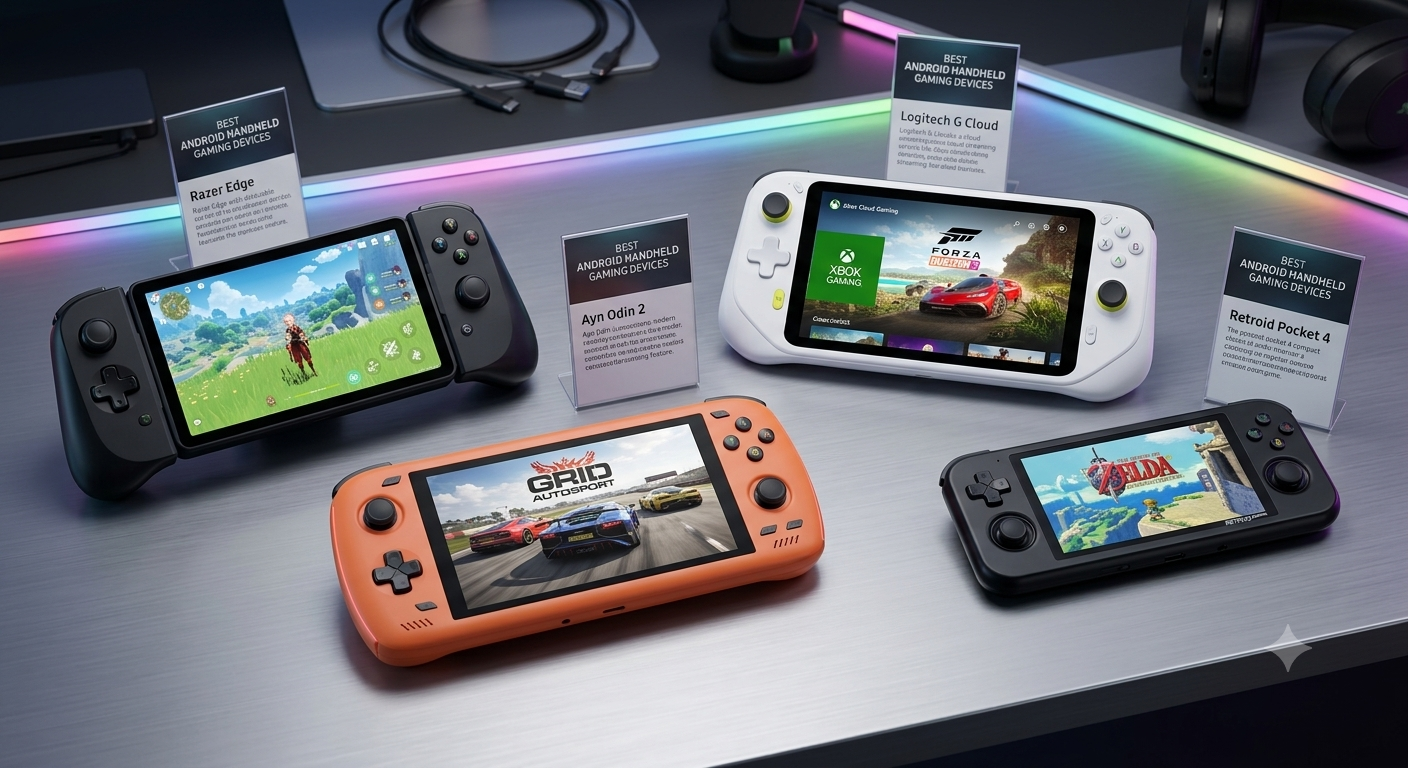
Best Android Handheld Gaming Devices in 2026: Top Picks for Every Budget
If you want portable gaming without carrying a full-size console, gaming laptop, or controller strapped to your phone, an Android handheld gaming device can be an excellent option. These compact systems combine a built-in screen, physical controls, rechargeable battery, and Android software in one portable package. Depending on the model, you can use an Android handheld for native mobile games, retro emulation, cloud gaming, remote play, and media apps.
The challenge is choosing the right one.
The Android handheld market now includes inexpensive retro-focused consoles, midrange devices with excellent OLED displays, and powerful premium systems built around flagship-class mobile processors. Current recommendations from Android Authority include the AYN Odin 2 Portal as an overall pick, the Retroid Pocket 5 as a value option, the AYANEO Pocket ACE for buyers wanting a smaller premium device, the ANBERNIC RG 477M for retro gaming, and the Retroid Pocket Classic for buyers shopping below $150.
So, what is the best Android handheld for you?
The answer depends on what you play, how much you want to spend, how portable the device needs to be, and whether you care more about raw performance or an easy, console-like experience.
Quick Answer: Which Android Handheld Should You Buy?
Best overall Android handheld: AYN Odin 2 Portal for buyers who prioritize a large, high-quality display and strong performance.
Best value Android handheld: Retroid Pocket 5 for shoppers who want a balance of price, AMOLED display quality, portability, and emulation performance.
Best Android handheld for demanding emulation: AYN Odin 2 or Odin 2 Portal, thanks to the Snapdragon 8 Gen 2 platform and the additional performance headroom it provides.
Best small Android handheld: AYANEO Pocket ACE for shoppers who want high performance in a smaller form factor.
Best retro-focused Android handheld: ANBERNIC RG 477M, which combines a 4:3 display with a Dimensity 8300 processor, 12GB of RAM, and Android 14.
Best budget Android handheld: Retroid Pocket Classic is one of the current options to consider if your priority is affordable retro gaming rather than maximum performance. Android Authority currently lists it as its pick under $150.
These recommendations are starting points rather than universal answers. A larger premium handheld may be ideal for someone playing at home, while a smaller device can make much more sense for commuting, travel, or casual gaming.
Best Android Handhelds at a Glance
| Android handheld | Best for | Display | Performance class | Ideal buyer |
| AYN Odin 2 Portal | Overall / big-screen gaming | 7-inch AMOLED | High | Gamers who want premium performance and a large screen |
| Retroid Pocket 5 | Value | 5.5-inch AMOLED | Mid-high | Most retro and Android gamers |
| AYN Odin 2 | Demanding emulation | Large IPS display | High | PS2, GameCube and advanced emulation enthusiasts |
| AYANEO Pocket ACE | Small premium handheld | Compact IPS | High | Gamers who want power in a smaller device |
| ANBERNIC RG 477M | Retro gaming | 4.7-inch 4:3 | High | Retro-focused players |
| Retroid Pocket Classic | Budget gaming | Compact retro-oriented display | Entry-mid | Buyers prioritizing price and portability |
Specifications and pricing can change, particularly for products sold directly by smaller international manufacturers. Check the manufacturer’s current US-facing pricing and availability before purchasing.
What Is an Android Handheld Gaming Device?
An Android handheld gaming device is a portable gaming system that uses Android as its operating system and includes built-in physical controls. Instead of relying on touchscreen controls like a smartphone, you get features such as analog sticks, a D-pad, face buttons, triggers, and shoulder buttons.
That combination makes an Android handheld different from simply attaching a controller to your phone.
Android also gives these devices considerable flexibility. Depending on the hardware and software, you can install compatible Android games, emulators, streaming applications, browsers, media apps, and other software. That makes the device more versatile than many traditional closed gaming consoles.
For many buyers, however, emulation is the main attraction. Android handhelds can provide a convenient portable platform for playing legally obtained game backups through compatible emulators. Performance varies substantially between devices, so a more expensive handheld isn’t automatically the best choice for every player.
Why Are Android Handhelds So Popular?
There are several reasons the category has grown.
First, mobile processors have become extremely capable. Modern ARM chips can deliver enough performance for demanding Android games and advanced emulation while remaining considerably more power-efficient than many traditional PC processors.
Second, Android provides an established software ecosystem. Buyers don’t have to learn an entirely new operating system from scratch.
Third, physical controls solve one of the biggest problems with smartphone gaming. Touchscreens work well for some games, but they are not ideal for platformers, fighting games, racing games, action games, or titles designed around traditional controllers.
Finally, an Android handheld can occupy a useful middle ground. It is more gaming-focused than a smartphone but generally smaller and simpler than a Windows gaming handheld.
Best Android Portable Game Console for Most Buyers: Retroid Pocket 5
The Retroid Pocket 5 is one of the strongest choices if you want a capable Android handheld without moving into the most expensive part of the market.
Retroid’s current product listing specifies a Snapdragon 865 platform, Adreno 650 graphics, 12GB of LPDDR4x RAM, 128GB of UFS 3.1 storage, a TF card slot, Android 13, active cooling, a 5.5-inch 1080p AMOLED display, a 5,000mAh battery, Hall-effect sticks, Wi-Fi 6, and Bluetooth 5.1.
That combination explains why the Pocket 5 continues to appear in current Android handheld recommendations.
Its biggest appeal isn’t raw performance. Instead, it offers a strong balance of display quality, portability, controls, battery capacity, and emulation capability.
Android Authority currently identifies the Retroid Pocket 5 as its best-value Android gaming handheld and highlights its AMOLED display, emulation performance, and battery life.
For a US buyer who wants one portable device for Android games, retro gaming, streaming, and a broad range of emulation, that balance can be more useful than spending considerably more for performance you may never use.
Why Choose the Retroid Pocket 5?
Choose it if you want:
- A compact horizontal Android handheld
- A 5.5-inch AMOLED screen
- Strong retro and emulation performance
- Expandable storage
- Physical gaming controls
- Active cooling
- A relatively affordable entry into higher-quality Android handheld gaming
Its main limitation is the Snapdragon 865 platform. It is still capable, but newer high-end Snapdragon hardware offers more performance headroom.
That matters most if you plan to push demanding emulation rather than primarily play older systems.
Best Premium Android Handheld: AYN Odin 2 Portal
If your priority is a premium experience rather than the lowest possible price, the AYN Odin 2 Portal deserves serious consideration.
Android Authority currently lists the Odin 2 Portal as its best overall Android gaming handheld, highlighting its performance, large display, and compatibility. The publication specifies a 7-inch 120Hz AMOLED panel and Snapdragon 8 Gen 2 processor.
This is a very different proposition from a pocket-sized retro console.
The large screen is particularly attractive for games that benefit from additional viewing space. It can also make Android interfaces, streaming services, and modern games easier to navigate.
The Snapdragon 8 Gen 2 provides considerably more performance headroom than the Snapdragon 865 found in the Retroid Pocket 5. That additional power becomes more relevant as you move into demanding emulation and more graphically intensive workloads.
The trade-off is size and price.
A large-screen premium handheld is not necessarily the best travel device. If you spend most of your time playing at home or want a more immersive portable display, however, the Portal’s larger form factor makes more sense.
Best Android Handheld for Demanding Emulation: AYN Odin 2
If your primary goal is high-performance emulation, the original AYN Odin 2 remains highly relevant.
The Odin 2 uses Qualcomm’s Snapdragon 8 Gen 2 platform, which gives it considerably more processing and graphics headroom than many midrange Android handhelds. Current 2026 comparisons continue to place the Odin 2 among the strongest Android options for demanding emulation.
That extra performance isn’t necessary for every retro system.
Older consoles can run well on much less powerful hardware. The reason to pay for a device like the Odin 2 is the additional ceiling for more demanding platforms and higher-resolution rendering.
For buyers specifically interested in systems such as PlayStation 2 and GameCube, that performance headroom can be more valuable than a beautiful specification sheet focused on screen resolution alone. Current comparisons continue to identify the Odin 2 as the stronger performer against the Retroid Pocket 5 in demanding PS2 and GameCube workloads.
The downside is simple: you pay for performance you may not need.
If your gaming library consists mostly of older 8-bit, 16-bit, arcade, or handheld titles, a less expensive Android handheld can provide a better value.
Best Small Android Handheld: AYANEO Pocket ACE
Not everyone wants a large handheld.
The AYANEO Pocket ACE targets buyers who want high performance in a smaller package. Android Authority currently identifies it as its best small Android gaming handheld and describes it as a compact device with enough performance for broad emulation.
This type of device makes sense for commuters, travelers, and gamers who dislike carrying a large console.
There is always a compromise when shrinking hardware, though.
A smaller screen can make certain games less comfortable, and compact controls may not suit every hand size. Before choosing a small handheld, consider whether portability or long-session comfort is more important to you.
For short gaming sessions, travel, and carrying the device in a smaller bag, compact hardware can be a major advantage.
Best Android Handheld for Retro Gaming: ANBERNIC RG 477M
The ANBERNIC RG 477M takes a more specialized approach.
ANBERNIC’s specifications list a 4.7-inch 1280×960 LTPS display with a 120Hz maximum refresh rate, a MediaTek Dimensity 8300 processor, Mali-G615 MC6 graphics, 12GB of LPDDR5 RAM, 256GB of UFS storage, Android 14, Wi-Fi 6E, and Bluetooth 5.3.
The 4:3 screen is particularly interesting for retro gaming because many classic systems were designed around similar aspect ratios.
That means you aren’t simply buying the most powerful Android handheld available. You’re buying a device designed around a particular style of gaming.
Android Authority currently identifies the RG 477M as its best Android handheld for retro consoles.
If most of your library consists of classic console and arcade games, the display format and physical controls can be more important than chasing the largest possible screen.
Best Budget Android Handheld: Retroid Pocket Classic
A budget buyer doesn’t necessarily need flagship hardware.
The Retroid Pocket Classic is aimed at people who want an affordable, compact Android handheld for retro-oriented gaming. Android Authority currently lists it as its pick for the best Android gaming handheld under $150.
This illustrates an important rule when shopping for an Android handheld: buy according to the games you want to play.
If you mainly want older systems, paying several hundred dollars for premium hardware may provide little practical benefit.
A budget handheld can give you the physical controls, portability, Android flexibility, and emulation experience you want without paying for performance that sits unused.
Android Handhelds by Budget
Your budget is one of the easiest ways to narrow the market.
Under $150
This range is best for buyers who prioritize affordability and retro gaming.
Expect compromises in processor performance, display quality, controls, storage, or build quality depending on the model. But you don’t need premium hardware to enjoy many classic games.
$150 to $250
This is where the market becomes especially interesting.
You can find devices with better displays, stronger processors, improved controls, and more polished software. The Retroid Pocket 5 is a strong example of why this segment attracts attention.
$250 to $400
This range opens the door to more powerful Android handhelds and premium displays. It makes more sense for users who want advanced emulation, better performance, or a larger screen.
$400 and above
At this point, you’re entering enthusiast territory.
A premium device can offer better materials, more powerful processors, higher-quality screens, additional RAM, or distinctive form factors. But the additional spending should be justified by your actual gaming needs.
What Should You Look for in the Best Android Handheld?
Choosing the best handheld Android gaming device isn’t about finding the biggest number in every specification category.
Instead, evaluate the complete experience.
1. Processor and GPU
The chipset determines how much performance you have available for Android games, emulation, and other workloads.
For basic retro gaming, you don’t need a flagship processor.
For demanding emulation, however, additional performance headroom can be valuable. Snapdragon 8 Gen 2 devices such as the Odin 2 family sit significantly above Snapdragon 865 devices such as the Retroid Pocket 5 in raw performance capability.
2. Display
Don’t look only at resolution.
Consider:
- Screen size
- OLED versus LCD
- Aspect ratio
- Refresh rate
- Brightness
- Touch support
- Viewing angles
- How the screen handles the games you play
For retro gaming, aspect ratio can be especially important.
For modern Android games and cloud gaming, a larger widescreen OLED can be more attractive.
3. Controls
A handheld can have an excellent processor and still be uncomfortable to use.
Look at the D-pad, analog sticks, face buttons, triggers, shoulder buttons, and overall layout.
Hall-effect sticks are also worth considering because they use magnetic sensing technology designed to reduce the mechanical wear associated with traditional potentiometer-based sticks.
4. Battery
Battery capacity is only part of the equation.
A more powerful processor may consume more energy under heavy workloads, while software optimization and display settings also influence battery life.
Look for independent testing whenever possible rather than assuming a larger battery automatically means longer gaming sessions.
5. Storage
Games, emulator files, apps, and system files can quickly consume storage.
A microSD or TF card slot can therefore be a valuable feature if the device supports expandable storage.
The Retroid Pocket 5, for example, includes 128GB of UFS 3.1 storage and a TF card slot.
6. Software and Updates
Android hardware is only half of the experience.
Look at the launcher, controller mapping, emulator compatibility, OTA updates, Wi-Fi and Bluetooth support, and manufacturer software.
A technically powerful device can become frustrating if the software requires excessive configuration.
Android-Based Handheld Emulator: What Can You Actually Emulate?
An Android-based handheld emulator is a portable Android gaming system configured to run emulation software.
But don’t interpret “supports emulation” as “runs every console perfectly.”
Different platforms require different levels of hardware performance. Older systems can be relatively easy to emulate, while later generations can require considerably more processing and graphics power.
Your choice should therefore begin with the systems you actually want to emulate.
If you’re focused on classic Nintendo, Sega, arcade, and early PlayStation-era games, you may have no reason to buy a premium Snapdragon 8 Gen 2 handheld.
If you’re targeting more demanding systems, spending more on hardware can give you useful performance headroom.
This is one reason current rankings distinguish Android handhelds from PC gaming handhelds. Android systems are particularly attractive for mobile gaming, retro emulation, and cloud gaming, while Windows or Linux gaming PCs are designed around native PC game libraries.
Android Handheld vs Gaming PC Handheld
An Android handheld and a gaming PC handheld serve different purposes.
An Android handheld typically offers:
- Lower complexity
- Android apps
- Strong mobile gaming support
- Excellent retro emulation potential
- Cloud gaming
- Lower-power hardware
- Often smaller and lighter designs
A PC handheld typically offers:
- Access to PC game libraries
- Windows or Linux
- More demanding native games
- Desktop software
- Greater hardware requirements
If your primary goal is Steam or native Windows gaming, don’t buy an Android handheld simply because it looks similar to a PC handheld.
If your main goal is portable Android gaming, emulation, and streaming, Android may be the more practical platform.
Android Handheld vs Gaming Phone
A gaming phone has one major advantage: you probably already use it for everyday tasks.
But a dedicated Android handheld has physical controls permanently attached.
That matters.
You don’t have to carry a separate controller, mount your phone into a controller, worry about blocking the screen with your fingers, or use your primary smartphone for extended gaming sessions.
On the other hand, a gaming phone is more versatile outside gaming.
If you already own a powerful Android phone, purchasing a handheld may only make sense if the dedicated controls, form factor, battery separation, or portability justify the additional cost.
Handhelds Menu and User Interface: Does It Matter?
Yes.
The handhelds menu or gaming launcher is more important than it may initially appear.
A good interface can organize your games, emulators, settings, and applications in a way that feels closer to a traditional console.
A poor interface can make a powerful handheld feel like a smartphone that happens to have buttons attached.
Before purchasing, look at screenshots and reviews of the device’s launcher. Find out whether you can customize the controls, organize games, adjust performance modes, and return to Android applications easily.
This is especially important for first-time buyers.
Experienced Android enthusiasts may enjoy configuring emulators and launchers. A casual player may prefer a device that works with minimal setup.
Handheld Equipment and Accessories You May Need
The handheld itself is only part of your portable setup.
Depending on how you use it, useful handheld gaming equipment can include:
- Protective case
- Screen protector
- MicroSD card where supported
- USB-C charger
- Spare charging cable
- Wired or Bluetooth headphones
- Travel adapter
- Grip or ergonomic case
Don’t assume you need every accessory.
If you mainly play at home, a case and charger may be enough. If you travel frequently, additional storage, protection, and compact charging equipment can become much more useful.
Are Android Handhelds Worth It in 2026?
For the right buyer, yes.
The category now offers enough variety that you don’t have to spend premium money to get a good experience. Current recommendations cover everything from sub-$150 retro-focused options to premium Snapdragon-powered handhelds costing several hundred dollars.
The key is matching the device to the use case.
An inexpensive handheld can be the smarter purchase if you mainly play older games. A Retroid Pocket 5 can make sense if you want a balanced combination of portability, AMOLED display quality, and performance. AYN’s Odin 2 family makes more sense if advanced emulation is a priority. And a large-screen device such as the Odin 2 Portal is attractive if you want a premium home-and-travel gaming experience.
The wrong approach is buying based purely on the highest processor specification.
The right approach is asking:
What games do I want to play, where will I play them, and how much am I comfortable spending?
Once you answer those three questions, the shortlist becomes much easier.
How We Recommend Android Handhelds
A useful Android handheld buying guide should evaluate more than processor benchmarks.
When comparing devices, consider these factors:
| Factor | Why it matters |
| Gaming performance | Determines what Android games and emulators the device can handle |
| Chipset | Influences CPU and GPU performance |
| Display | Affects image quality, aspect ratio, brightness, and comfort |
| Controls | Determines how enjoyable longer gaming sessions feel |
| Battery | Important for travel and extended play |
| Portability | Determines how practical the handheld is to carry |
| Software | Affects setup, launcher experience, and updates |
| Storage | Determines how many games and apps you can keep installed |
| Connectivity | Matters for cloud gaming, streaming, downloads, and accessories |
| Price | Determines overall value |
This approach prevents a common mistake: treating specifications as the entire product.
Two handhelds can have similar processors but feel completely different because of their displays, controls, cooling, software, and ergonomics.
Final Verdict: Which Android Handheld Is Best for You?
The best Android portable game console depends on your priorities.
If you want a premium, large-screen experience, the AYN Odin 2 Portal is one of the strongest choices to consider. Android Authority currently ranks it as its overall Android gaming handheld pick and highlights its Snapdragon 8 Gen 2 processor and 7-inch 120Hz AMOLED display.
If you want the strongest combination of price and features, the Retroid Pocket 5 is an excellent value-focused choice. Its Snapdragon 865, 5.5-inch 1080p AMOLED display, 12GB RAM, active cooling, 5,000mAh battery, Hall-effect sticks, and expandable storage give it a well-rounded feature set.
If demanding emulation is your priority, the AYN Odin 2 deserves attention because its Snapdragon 8 Gen 2 platform gives it substantially more performance headroom than many midrange Android handhelds.
For a smaller premium option, consider the AYANEO Pocket ACE. For retro-focused gaming, the ANBERNIC RG 477M stands out with its 4:3 display and powerful Dimensity 8300 platform. And if you’re primarily looking for an inexpensive way into portable Android retro gaming, the Retroid Pocket Classic is a strong budget category candidate.
There isn’t one device that wins for everyone.
The best handheld Android gaming device is the one that gives you enough performance for your games without making you pay for hardware you don’t need.
For most buyers, start with your gaming library, set a realistic US-dollar budget, decide how portable you want the device to be, and then compare the screen, controls, battery, chipset, software, and storage.
That approach will lead you to a much better purchase than simply choosing the handheld with the biggest specification sheet.
FAQs About Android Handheld Gaming Devices
What is the best Android handheld gaming device in 2026?
The best Android handheld depends on your priorities. The AYN Odin 2 Portal is a strong premium overall option, while the Retroid Pocket 5 is a compelling value choice. Buyers focused on demanding emulation should also consider the AYN Odin 2, while retro-focused shoppers may prefer the ANBERNIC RG 477M.
What is the best Android handheld under $150?
The Retroid Pocket Classic is one of the current options to consider under $150. Android Authority currently lists it as its best Android gaming handheld in that price category.
Can Android handhelds run emulators?
Yes. Android handhelds are commonly used for emulation, particularly retro gaming. The level of performance varies by chipset, emulator, operating system, graphics drivers, and the individual game. More demanding platforms generally require more powerful hardware.
Is an Android handheld better than a gaming phone?
It depends. A gaming phone is more versatile as an everyday device, while an Android handheld provides built-in physical controls and a gaming-focused form factor. If you frequently play controller-based games, a dedicated handheld can be more convenient than carrying a separate controller for your phone.
Can an Android handheld replace a Steam Deck?
Not necessarily. Android handhelds and PC gaming handhelds target different use cases. Android devices are particularly useful for Android gaming, emulation, cloud gaming, and remote play, while a Steam Deck-style PC handheld is designed around native PC gaming.
What should I look for in an Android handheld?
Start with the chipset, display, controls, battery, storage, cooling, software, connectivity, and price. Most importantly, determine which games and emulators you intend to use. You don’t need flagship hardware if your library consists primarily of older games.
Are Android handhelds good for travel?
Yes. Their built-in controls, rechargeable batteries, and compact form factors make them well suited to travel. For frequent travelers, prioritize portability, battery life, screen brightness, durable construction, and expandable storage.
Do Android handhelds support cloud gaming?
Many Android handhelds can support compatible cloud gaming services because they run Android and have Wi-Fi connectivity. However, cloud gaming depends heavily on internet speed, latency, and connection stability, so local games remain useful when traveling without reliable internet access.
Is OLED important on an Android gaming handheld?
OLED can provide deeper blacks and strong contrast, which can make games and media look excellent. However, OLED should not be the only factor you consider. Processor performance, controls, battery life, ergonomics, software, and price may matter more depending on how you use the handheld.
Should I buy the most powerful Android handheld available?
Not necessarily. The most powerful device only makes sense if you will use the additional performance. If you primarily play older retro games, a cheaper handheld may deliver the better value. If you want demanding emulation, modern Android games, or additional performance headroom, spending more can be justified.
Tagged: best android handheld handheld android gaming device