
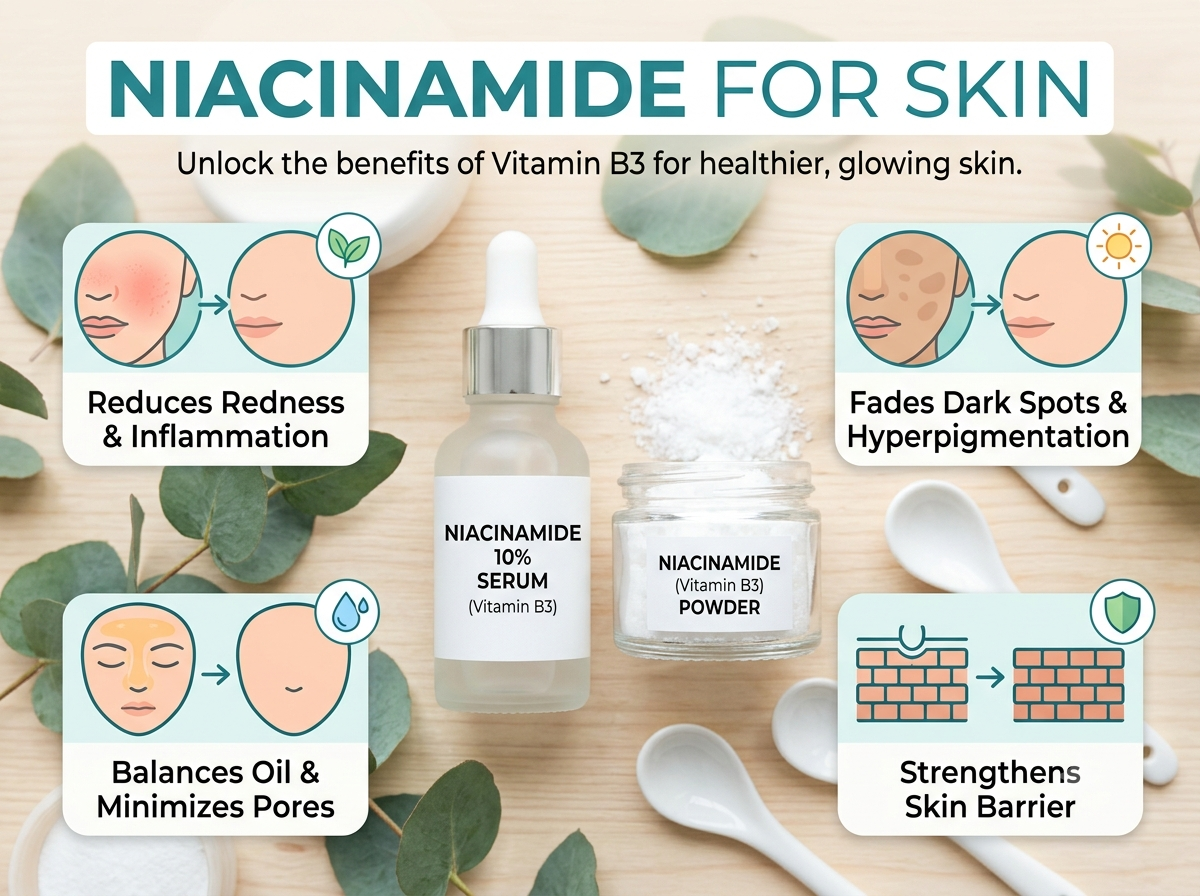
Niacinamide has become one of the most widely used skincare ingredients in the United States, and there is a good reason for its popularity. This form of vitamin B3 can support the skin barrier, help improve the appearance of uneven pigmentation, and complement routines designed for acne-prone, oily, dry, or sensitive skin. But with so many products advertising 5%, 10%, or even higher concentrations, it is easy to wonder what niacinamide actually does and how quickly you should expect results. Questions such as how long does it take for niacinamide to work, does niacinamide whiten skin, and should I use niacinamide everyday are especially common because skincare results rarely happen overnight.
Current research supports niacinamide as a multifunctional topical ingredient rather than a single-purpose treatment. Reviews of clinical evidence have associated topical niacinamide with improvements in skin barrier function, pigmentation, acne-related concerns, and signs of skin aging. It can also be useful when paired with other well-established skincare ingredients, although the best routine depends on your skin type and concern. The important distinction is that niacinamide does not bleach your natural skin tone. Instead, it may help make uneven pigmentation appear less noticeable and support a healthier-looking complexion over time. Below is a practical guide to what niacinamide can do, when to use it, how often to apply it, and what to do if your skin burns, stings, or becomes dry.
What Is Niacinamide?
Niacinamide, also called nicotinamide, is a form of vitamin B3 used in both skincare and nutrition. In topical skincare, it is commonly included in serums, moisturizers, toners, creams, and other formulations. Unlike some exfoliating acids or retinoids, niacinamide is generally considered a relatively gentle ingredient and can fit into routines for several different skin types. Research reviews describe it as having barrier-supporting, anti-inflammatory, antioxidant, and pigmentation-related properties, which helps explain why it appears in so many products targeting different concerns.
One reason niacinamide is appealing is its versatility. Someone with oily skin may use it as part of a routine focused on excess oil and blemishes, while someone with dry or sensitive skin may choose it because of its potential role in supporting the skin barrier. It is also frequently included in products designed for uneven tone and visible dark spots. That does not mean it will solve every skin problem by itself. Skincare is more like building a balanced team than finding one superstar ingredient that does everything. Niacinamide can play an important role, but sunscreen, cleansing, moisturizing, and condition-specific treatments can be equally important.
Is Niacinamide a Peptide?
No. Niacinamide is not a peptide. It is a form of vitamin B3, whereas peptides are short chains of amino acids. The two ingredient categories are chemically and biologically different, even though both can appear in anti-aging and skin-supporting formulas.
This distinction matters when you are comparing skincare products. Peptides are commonly marketed for their role in supporting the appearance of firmness and other signs associated with aging, while niacinamide has a broader range of researched cosmetic applications, including barrier support and pigmentation. A product can contain both, but niacinamide does not become a peptide simply because it appears in a serum marketed for anti-aging. If you are building a routine, you do not generally need to choose between the two solely because they belong to different ingredient families. The better question is what your skin needs and whether the complete formula is suitable for you.
What Does Niacinamide Do for Your Skin?
Niacinamide is best thought of as a multifunctional skincare ingredient. Research has explored its potential effects on the skin barrier, pigmentation, inflammation, acne, and visible signs of aging. A 2024 review of clinical evidence describes topical niacinamide as having applications across several dermatological and cosmetic concerns, including acne, dermatitis, pigmentation, and skin aging.
Its versatility is particularly useful when you do not want an unnecessarily complicated skincare routine. For example, if you are dealing with oily skin and occasional blemishes while also trying to improve uneven tone, a niacinamide product may address several goals within one routine. It is also frequently used alongside moisturizers and sunscreen rather than replacing them. The goal should not be to use as many active ingredients as possible. Instead, choose a manageable routine that you can consistently follow without irritating your skin.
Another reason niacinamide attracts attention is that its potential benefits are not limited to appearance alone. Research indicates that nicotinamide can influence the production of important components involved in the skin barrier, including ceramides and other lipids. This is one reason niacinamide is often included in formulas intended for dry, stressed, or compromised-looking skin.
How Niacinamide Supports the Skin Barrier
Your skin barrier acts somewhat like a protective wall. It helps keep water inside the skin while limiting the impact of environmental stressors. When that barrier becomes disrupted, skin can feel dry, tight, rough, or unusually sensitive. Niacinamide has been studied for its potential to support barrier function by influencing the production of skin lipids and proteins involved in epidermal structure.
This is where the ingredient becomes particularly interesting for people who use several active products. Exfoliating acids, retinoids, acne treatments, environmental exposure, and over-cleansing can all contribute to irritation when used improperly. A well-formulated niacinamide moisturizer or serum may complement a routine designed around barrier support. However, more is not automatically better. If a product contains a high concentration of niacinamide plus several other potentially irritating actives, the overall formula matters more than the headline percentage on the bottle.
How Long Does It Take for Niacinamide to Work?
If you are wondering how long does it take for niacinamide to work, the realistic answer is that it depends on what you are trying to improve. Some people notice changes in how their skin feels relatively early, especially when using niacinamide as part of a barrier-supporting routine. Visible changes in uneven pigmentation, acne-related marks, or overall tone generally require more consistent use over several weeks.
Clinical research provides some useful context. One study found significant reductions in facial hyperpigmentation and increased skin lightness after four weeks of using a 5% niacinamide moisturizer compared with a vehicle moisturizer. Other research involving niacinamide-containing formulations has evaluated visible pigmentation changes over periods of several weeks to a few months. These findings do not mean every person will see the same result in exactly four weeks. Skin type, concentration, formulation, sun exposure, the cause of pigmentation, and the rest of your skincare routine can all affect the outcome.
If you have been using niacinamide consistently for several weeks without seeing improvement, that does not necessarily mean the ingredient is ineffective. Your particular concern may require a different treatment approach. Persistent acne, melasma, significant hyperpigmentation, or worsening irritation is a good reason to speak with a dermatologist rather than continually adding more products.
When to Expect Results for Different Skin Concerns
The timeline for niacinamide varies because different skin concerns have different biological causes. A barrier-related concern may improve sooner than stubborn pigmentation. Acne can also require a longer period of consistent treatment, especially when the goal is to prevent new breakouts as well as improve existing marks. The American Academy of Dermatology notes that acne treatments commonly require several weeks before noticeable improvement and longer periods for substantial clearing.
As a practical guide, think in terms of weeks rather than days. If your skin tolerates the product, use it consistently and assess your progress periodically rather than checking your face every morning for dramatic changes. Take photographs under similar lighting if you want a more objective way to compare pigmentation over time. Also remember that sunscreen matters enormously when you are trying to improve dark spots. A systematic review of topical treatments for post-inflammatory hyperpigmentation found that broad-spectrum sunscreen with SPF 30 or greater was recommended in almost every study reviewed.
Does Niacinamide Whiten or Lighten Skin?
Niacinamide does not bleach or whiten your natural skin color. It is more accurate to describe it as an ingredient that can help improve the appearance of uneven pigmentation and promote a more even-looking complexion. Research has investigated niacinamide’s effects on pigmentation and found evidence that it can reduce melanosome transfer between melanocytes and keratinocytes, a process involved in pigmentation.
This distinction is important because “whitening” can imply that a product changes someone’s natural skin tone. That is not the best way to understand niacinamide. When people ask does niacinamide lighten skin, they are often actually asking whether it can make dark spots, post-acne marks, or uneven areas appear less noticeable. In that context, there is scientific evidence supporting a role for niacinamide in improving the appearance of pigmentation.
If your goal is brighter-looking skin, think about the entire routine rather than relying on one serum. Daily broad-spectrum sunscreen, gentle cleansing, adequate moisturization, and a targeted active can work together more effectively than repeatedly increasing the strength of one product.
Does Niacinamide Help With Hyperpigmentation?
Yes, niacinamide can help improve the appearance of hyperpigmentation, although it should not be considered a universal treatment for every pigmentation disorder. Clinical studies have found reductions in facial pigmentation with topical niacinamide, and research has proposed that its pigmentation-related activity is associated in part with reduced melanosome transfer rather than simply stopping melanin production.
This makes niacinamide particularly relevant for people dealing with uneven tone and post-inflammatory pigmentation. A systematic review of treatments for post-inflammatory hyperpigmentation identified niacinamide among topical agents supported by high-quality studies, while also emphasizing the importance of sunscreen. More recent dermatologist consensus research also lists niacinamide among ingredients reaching consensus for addressing dark spots.
Still, pigmentation can have many causes. Acne marks, sun-related spots, melasma, irritation, hormonal changes, and other conditions do not necessarily respond in exactly the same way. If pigmentation is persistent, rapidly changing, widespread, or difficult to identify, professional evaluation is more useful than trying increasingly aggressive over-the-counter products.
Niacinamide for Dark Spots and Acne Marks
Niacinamide can be a useful option for post-acne dark marks, particularly when the goal is to support a consistent, gentle routine. Acne-related inflammation can leave post-inflammatory hyperpigmentation, and these marks can be especially persistent in people with medium-to-dark skin tones. The AAD notes that dark spots can remain after acne clears and that dermatologists can help develop treatment plans when pigmentation is persistent.
Niacinamide should not be confused with a scar-removal ingredient. A flat brown mark left after a pimple is different from a depressed or raised acne scar. Niacinamide may help with the appearance of pigmentation, but structural acne scars generally require different approaches. If you are unsure whether you have a scar or a dark mark, identifying the concern correctly is the first step toward choosing an appropriate treatment.
Is Niacinamide Good for Acne Scars?
The answer depends on what you mean by acne scars. If you are referring to dark marks left after acne, niacinamide may help improve their appearance as part of a broader skincare routine. Research has investigated topical niacinamide in acne and pigmentation-related applications, including studies involving acne treatment and post-inflammatory pigmentation.
If you mean indented scars, rolling scars, boxcar scars, or raised scars, niacinamide is not a proven stand-alone solution for changing the physical structure of those scars. Those concerns involve changes deeper in the skin and may require treatments such as procedures or prescription options chosen by a dermatologist. This distinction can save you a lot of frustration. Applying more serum to a textured scar does not necessarily mean you will get a stronger result.
For people with active acne, controlling new inflammation is also important because repeated breakouts can create additional marks. A clinical study evaluating 5% niacinamide with benzoyl peroxide found benefits for mild-to-moderate facial acne compared with benzoyl peroxide alone, although treatment outcomes varied by measure.
Niacinamide for Dark Circles and Under-Eye Skin
Niacinamide can be used around the eyes when the specific product is formulated and labeled for that area, but expectations should remain realistic. Dark circles are not caused by one single problem. Genetics, visible blood vessels, pigmentation, shadows from facial anatomy, allergies, sleep-related factors, and skin thinning can all contribute to the appearance of under-eye darkness.
If your dark circles are primarily related to pigmentation, a well-tolerated niacinamide product may help improve the appearance of uneven tone over time. However, it will not necessarily correct dark circles caused by hollowness or natural facial structure. The under-eye area is also more delicate than many other parts of the face, so introducing a new active there deserves extra caution.
When using niacinamide under eyes, avoid getting the product directly into your eyes. Start slowly, especially if you have sensitive skin, and discontinue use if you experience persistent burning, swelling, or significant irritation. A product specifically designed for the eye area may be a better choice than applying a highly concentrated facial serum close to the eyelids.
When Should You Use Niacinamide?
You can generally use niacinamide in the morning, at night, or both, depending on the formulation and your overall routine. There is no universal rule that says niacinamide must be used at a particular time of day. Its usefulness comes from consistent application rather than choosing a magical hour.
For a morning routine, niacinamide can fit comfortably after cleansing and before moisturizer and sunscreen. For an evening routine, it can be applied after cleansing and before moisturizer, assuming the product directions support that order. If you use other active ingredients, introduce products gradually rather than adding several new actives at the same time.
For people primarily concerned about pigmentation, morning skincare has an important advantage: it gives you the opportunity to finish with sunscreen. Since UV and visible light can contribute to pigmentation and worsen post-inflammatory darkening, sun protection should not be treated as an optional extra when your goal is a more even complexion.
Should You Use Niacinamide Every Day?
For many people, daily niacinamide use is reasonable if the product is well tolerated. However, daily use is not mandatory for everyone. If you have sensitive skin or are introducing several new products, starting every other day can make it easier to identify how your skin responds.
The concentration also matters, although higher does not automatically mean better. Niacinamide is available in many formulations and concentrations, and the overall formula can influence how comfortable a product feels. A product containing a moderate concentration may be a better everyday choice than an extremely strong formula that causes irritation.
Consistency matters more than chasing maximum strength. If a product leaves your skin comfortable and you can use it regularly, that routine is generally more sustainable than using a stronger product sporadically because it causes burning or dryness. Cosmetic safety assessments have found niacinamide to be well tolerated at concentrations used in cosmetics, but individual products and individual skin responses can differ.
How Often Should You Use Niacinamide?
If you are asking how often should you use niacinamide, a practical starting point is once daily. If your skin tolerates it well, some people may use it twice daily depending on the product’s instructions. Sensitive skin does not need to follow the same schedule as resilient skin.
When starting a new niacinamide serum, apply a small amount to clean skin according to the product directions. Give your skin time to adjust before adding additional actives. This is particularly useful if your routine already contains retinoids, exfoliating acids, benzoyl peroxide, or other potentially irritating treatments.
If your skin becomes persistently red, painful, itchy, or unusually dry, reduce frequency or stop the product and reassess your routine. More frequent application is not guaranteed to produce faster results. Skincare is not a race where the person using the most product wins. The best routine is the one that supports your skin without creating a cycle of irritation and recovery.
Niacinamide Morning or Night: Which Is Better?
There is no universal winner in the niacinamide morning or night debate. Niacinamide can be incorporated into either routine, so choose the time that makes it easiest for you to use consistently. If you already have a complicated evening routine, adding it in the morning may be simpler.
A basic morning routine could include a gentle cleanser, niacinamide serum, moisturizer, and broad spectrum sunscreen. At night, you could use a gentle cleanser, niacinamide, moisturizer, and other treatments appropriate for your skin. The exact order can vary depending on the formulas involved, so product instructions should take priority.
If pigmentation is your main concern, morning application alongside sunscreen can make practical sense because sun protection is a core part of managing pigmentation. Research on post-inflammatory hyperpigmentation consistently emphasizes sunscreen as an important component of treatment. The important thing is not whether you choose 8 a.m. or 8 p.m.; it is whether the routine is appropriate and sustainable.
Is Niacinamide Drying for Your Skin?
Niacinamide is not generally considered inherently drying, and it is often included in products designed to support the skin barrier. Research has linked topical niacinamide with increased synthesis of certain barrier-related lipids, including ceramides and other components.
However, that does not mean every niacinamide product will feel moisturizing. The product may contain other ingredients that affect how your skin feels, and individual skin can respond differently. A high concentration serum combined with exfoliating acids, retinoids, or harsh cleansing may leave your skin feeling dry even if niacinamide itself is not the primary cause.
If you are wondering does niacinamide dry your skin, look at the entire routine rather than blaming one ingredient immediately. Tightness, flaking, burning and persistent redness may indicate that your overall routine is too aggressive. Simplifying your routine and adding a bland moisturizer can often be more useful than adding another active ingredient.
Why Does Niacinamide Burn or Sting?
If niacinamide burns, something about the product or your skin’s current condition deserves attention. Niacinamide is generally considered well tolerated, but individual reactions can happen, and the overall formulation matters. Clinical safety data have reported low irritation potential for niacinamide at commonly used cosmetic concentrations, but that does not guarantee that every person will tolerate every product.
Possible reasons for burning or stinging include a damaged skin barrier, very sensitive skin, a high concentration formula, other active ingredients in the product, or irritation caused by using multiple new products at once. Sometimes people also mistake a temporary sensation for proof that an ingredient is working. Burning is not a requirement for effective skincare.
If you experience niacinamide burns, stop using the product if the sensation is significant or persistent. Rinse it off if appropriate, keep the routine simple, and avoid repeatedly testing the same product on irritated skin. Severe swelling, blistering, or other concerning symptoms warrant medical attention. A dermatologist can help determine whether you are experiencing irritation, allergic contact dermatitis, or another skin condition.
Niacinamide vs. Ceramide: What’s the Difference?
The niacinamide vs. ceramide comparison can be confusing because both are associated with skin barrier support, but they are not the same type of ingredient. Niacinamide is a form of vitamin B3, while ceramides are lipids naturally found in the skin’s outer layers.
Think of the difference this way: niacinamide can help support the processes involved in maintaining the barrier, while ceramides are themselves important components of that barrier. Research indicates that niacinamide can increase the synthesis of ceramides and other barrier-related lipids in skin cells.
| Feature | Niacinamide | Ceramides |
| What it is | Form of vitamin B3 | Lipid/fat naturally found in skin |
| Main skincare role | Multifunctional, including barrier and pigmentation support | Barrier and moisture-loss support |
| Common concerns | Uneven tone, oily skin, blemishes, barrier support | Dryness, barrier disruption, moisture retention |
| Can they be combined? | Yes | Yes |
| Must you choose one? | Not necessarily | Not necessarily |
So, ceramide vs. niacinamide is not necessarily an either-or decision. Many moisturizers combine them because they can complement each other.
Are Niacin and Niacinamide the Same Thing?
Niacin and niacinamide are different forms of vitamin B3. They share a vitamin relationship but have different chemical properties and physiological effects. Niacin is also known as nicotinic acid, while niacinamide is nicotinamide.
One important difference is that niacin can cause flushing at supplemental doses, whereas niacinamide does not produce the same characteristic flushing effect. A scientific review notes that niacinamide has the same vitamin activity as nicotinic acid while having different pharmacological effects and side effects.
For skincare shoppers, this distinction is useful because a cosmetic product labeled niacinamide is specifically using the nicotinamide form. Do not assume that a product containing niacin or another vitamin B3 derivative will behave identically on your skin. Always check the ingredient list and product directions rather than relying only on the broader phrase “vitamin B3.”
Does Niacinamide Expire?
Yes, niacinamide products can expire. Like other cosmetic formulations, they should be stored according to the manufacturer’s instructions and replaced when they reach their stated expiration date or recommended period after opening.
Do not assume that a product is safe or effective indefinitely simply because it still looks normal. Heat, light, air exposure, moisture, and contamination can affect cosmetic products over time. Keeping skincare in a cool, dry place and closing containers properly can help maintain product quality.
If the color, smell, texture, or consistency changes significantly, stop using the product and check the manufacturer’s guidance. The expiration date and period-after-opening symbol on the packaging are more useful than trying to determine freshness by appearance alone.
How to Add Niacinamide to a Skincare Routine
Adding niacinamide does not require rebuilding your entire skincare shelf. In fact, a simple routine is often easier to maintain. Start with a gentle cleanser, then apply your niacinamide product according to its directions. Follow with moisturizer when needed, and use broad-spectrum sunscreen during the daytime.
If your primary concern is hyperpigmentation, do not overlook sunscreen. Research on post-inflammatory hyperpigmentation repeatedly identifies sun protection as an important part of the overall approach. This matters because continued UV and visible-light exposure can work against your efforts to improve uneven pigmentation.
A straightforward routine can look like this:
- Cleanser: Use a gentle cleanser appropriate for your skin type.
- Niacinamide: Apply your serum or treatment according to its label.
- Moisturizer: Use one that supports your skin’s needs.
- Sunscreen: In the morning, finish with broad-spectrum SPF 30 or higher.
At night, sunscreen is not needed, but cleansing and moisturizing remain important. If you use prescription treatments or strong active ingredients, follow your dermatologist’s instructions rather than automatically layering everything together.
Common Niacinamide Mistakes to Avoid
One of the biggest mistakes is assuming that a higher percentage of niacinamide automatically means better results. It does not. Skin care is about effectiveness and tolerability, and a product that causes irritation may ultimately be less useful than a gentler formula you can consistently use.
Another mistake is expecting niacinamide to transform the skin overnight. Questions such as how long does niacinamide take to work are understandable, but visible changes generally require consistent use over time. Clinical studies assessing pigmentation have measured results over weeks rather than days.
A third mistake is using too many actives simultaneously. If you introduce niacinamide, a new exfoliant, a retinoid, and a new acne treatment all in the same week, you may have no idea which product caused irritation. Introduce products gradually so you can understand how your skin responds.
Finally, do not treat every dark spot as the same condition. A post-acne mark, melasma, sun spot, and structural under-eye shadow can look similar in casual lighting but have different causes. When pigmentation is persistent or concerning, professional evaluation can be more valuable than endlessly changing products.
Conclusion
Niacinamide is a versatile skincare ingredient with evidence supporting several cosmetic and dermatological applications, including skin barrier support, uneven pigmentation, acne-related concerns, and visible signs of aging. Research suggests that topical niacinamide can influence barrier-related lipids and reduce certain pigmentation processes, while clinical studies have reported improvements in the appearance of hyperpigmentation with consistent use.
The answer to how long does it take for niacinamide to work depends on your goal. Some changes may become noticeable within several weeks, while stubborn pigmentation or acne-related concerns can require longer and more comprehensive care. Niacinamide does not bleach the skin, and it should not be viewed as a replacement for sunscreen or condition-specific treatment. It is better understood as a supportive ingredient that can help create a more balanced, even-looking complexion.
For most people, the smartest approach is simple: choose a well-formulated product, introduce it gradually, use it consistently, moisturize as needed, and protect your skin from the sun. If niacinamide causes persistent burning, dryness, redness, or another concerning reaction, stop and reassess rather than assuming irritation means the product is working. When skin concerns are persistent, severe, or difficult to identify, a dermatologist can help determine the underlying cause and the most appropriate treatment.
FAQs About Niacinamide
1. How long does niacinamide take to work on dark spots?
Visible changes can take several weeks or longer. Clinical research has reported improvements in facial hyperpigmentation after about four weeks in some study settings, while other studies have evaluated results over longer periods. Individual results vary depending on the cause of pigmentation, product formulation, consistency, sun exposure, and other treatments used.
2. Can I use niacinamide every day?
Yes, many people can use niacinamide daily when their skin tolerates the product. Once-daily use is a practical starting point, while some formulations can be used twice daily according to their directions. If you have sensitive or irritated skin, start less frequently and increase use gradually if comfortable.
3. Does niacinamide whiten skin?
No. Niacinamide does not bleach your natural skin tone. It can help reduce the appearance of uneven pigmentation and dark spots, which may make the complexion appear brighter and more even. Research has linked its pigmentation effects partly to reduced melanosome transfer.
4. Why does niacinamide burn my skin?
Burning or stinging may occur because of irritation, a compromised skin barrier, the concentration of the product, or other ingredients in the formulation. Niacinamide is generally considered well tolerated, but no cosmetic ingredient is guaranteed to suit every person. If burning is persistent or significant, discontinue the product and seek professional advice if necessary.
5. Which is better: ceramide or niacinamide?
Neither is universally “better.” Niacinamide is a vitamin B3 derivative with several potential skincare benefits, while ceramides are lipids that are important components of the skin barrier. They can complement each other, and many skincare products contain both.
Tagged: niacinamide niacinamide hyperpigmentation