
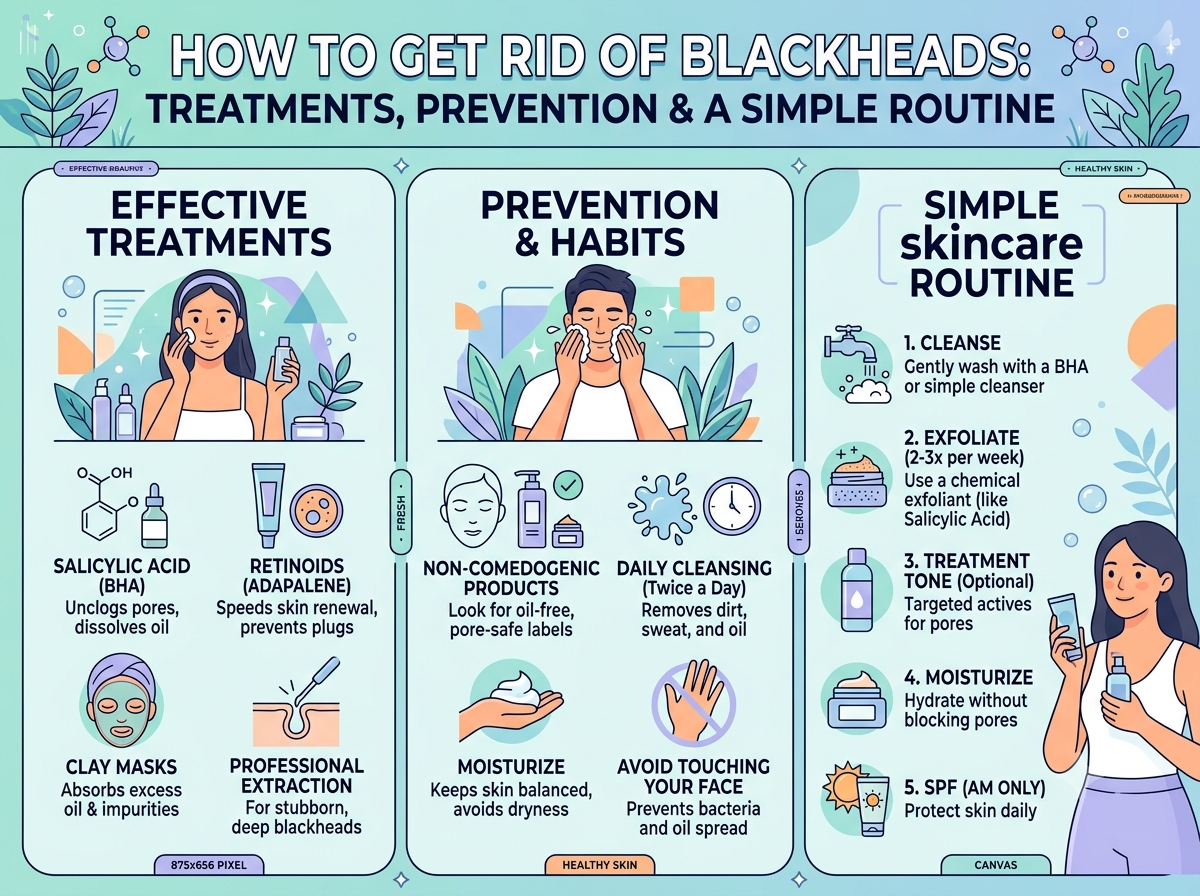
How to Get Rid of Blackheads: Treatments, Prevention & a Simple Routine
Blackheads are one of those skin problems that seem to come back no matter how carefully you wash your face. You may notice them most around your nose, but they can also show up on your forehead, chin, cheeks, & other areas where your skin tends to produce more oil.
And when you see those little black dots in the mirror, it is easy to think they are dirt trapped in your pores. That is usually the first mistake.
Scrubbing harder, squeezing them with your fingers, or trying a new internet hack every few days can leave your skin red & irritated without actually stopping new blackheads from appearing.
The good news? You do not need an elaborate skincare routine to deal with them.
A few sensible steps-gentle cleansing, the right acne treatment, moisturizer, & sunscreen-can make a noticeable difference when you stick with them. For people in the United States, over-the-counter ingredients such as salicylic acid & adapalene are also readily available & commonly used for clogged pores & acne.
If you have been searching for how to remove blackheads from face, how do I get rid of blackheads or how to prevent blackheads, this guide will walk you through what is actually happening inside your pores, what treatments are worth trying, what you should stop doing, & when it is time to see a dermatologist.
What Are Blackheads & Why Do They Appear?
A blackhead is a type of acne known as an open comedone.
It starts when oil, dead skin cells & other material collect inside a hair follicle. Eventually, that mixture forms a plug. Because the opening of a blackhead remains open, the contents are exposed to air & take on that familiar dark appearance.
You will often find blackheads on the nose, forehead, & chin because these areas can produce more oil. Still, they are not limited to the T-zone. They can occur in other areas of the face & even on the body.
Here is something worth remembering: blackheads do not mean your face is dirty.
Washing your face ten times a day will not stop your pores from becoming clogged. In fact, aggressive cleansing can irritate the skin & damage its protective barrier.
Your skin naturally produces sebum. At the same time, old skin cells are constantly being shed. Sometimes those substances collect inside a follicle instead of clearing away normally. Hormonal changes can also influence how much oil your skin produces.
That is why someone can have a very careful skincare routine & still deal with blackheads.
The better approach is not to scrub the spots away. It is to keep the follicles from becoming clogged in the first place.
Ingredients such as salicylic acid & retinoids can help with that.
Why Blackheads Turn Black
The color is probably the most confusing part.
A lot of people see a blackhead & assume the dark material must be dirt. It is not simply dirt sitting inside the pore.
Because a blackhead is open to the air, the material inside the follicle is exposed to oxygen. That exposure contributes to the dark color.
Think about what happens to a sliced apple when it is left sitting out. The surface gradually changes color after being exposed to air. Nobody has to throw dirt on the apple for that to happen.
Blackheads work on a similar basic principle.
Once you know this, the urge to attack the spots with a rough scrub starts to make less sense.
Squeezing them can damage the surrounding skin. Picking at them with your nails is even less helpful. Besides irritation, repeated picking can increase the risk of inflammation & scarring.
It can be frustrating to leave a blackhead alone when it is sitting right there in the mirror. But treating the cause is usually more useful than trying to remove every visible spot immediately.
Think of it as maintenance rather than a one-time cleanup.
Topical Treatments for Blackheads
When you are looking for topical treatments for blackheads, do not get too caught up in products that have “blackhead remover” written across the label.
The active ingredient matters more.
For mild blackheads, over-the-counter acne products can be a reasonable starting point. Ingredients such as salicylic acid & retinoids are commonly used for clogged pores. Depending on what else is happening with your skin, a dermatologist may also recommend ingredients such as azelaic acid or benzoyl peroxide.
One thing you should not do is start everything at once.
It can seem logical to combine an acid, retinoid, scrub, mask, toner, & spot treatment. More treatment must mean faster results, right?
Not necessarily.
Your skin can become dry, flaky, red, or painfully irritated. & once that happens, keeping up with the routine becomes much harder.
Starting with one suitable active ingredient gives you a better idea of how your skin responds. You can always adjust your routine later.
Salicylic Acid
Salicylic acid is probably one of the first ingredients you will come across when researching blackheads.
It is a beta hydroxy acid, usually called BHA, & is commonly found in acne cleansers & leave-on treatments. Because it works well in oily areas, it is often used to help clear the buildup that contributes to clogged pores.
If you are wondering how can I get rid of blackheads, salicylic acid is one option worth knowing about.
In the United States, over-the-counter acne products commonly contain between 0.5% & 2% salicylic acid, depending on the product.
More is not automatically better, though.
Using it too often can leave your face dry or irritated. If you have sensitive skin, start slowly & follow the instructions that come with the product.
A salicylic acid cleanser may be easier for some beginners because you rinse it off. Leave-on treatments remain on the skin for longer & can provide more prolonged contact, but they may also cause more irritation.
Whichever type you choose, give it time.
Changing products every few days will not tell you whether the ingredient is actually helping.
Adapalene & Other Retinoids
If blackheads continue to appear even after using an exfoliating product, adapalene is another ingredient to consider.
Adapalene is a topical retinoid. Rather than simply exfoliating the surface of your skin, it helps normalize the way skin cells shed inside the follicles.
That makes it particularly useful for comedonal acne, which includes blackheads & whiteheads.
In the United States, adapalene 0.1% is available without a prescription.
There is one catch: it takes patience.
When you first start using adapalene, your skin may become dry, flaky, or irritated. This does not mean you should apply more in an attempt to make it work faster.
A small amount is enough. Follow the product directions & give your skin time to adjust.
Moisturizer can help make the routine more comfortable, & sunscreen should be part of your daytime routine.
If you are pregnant, planning to become pregnant, or breastfeeding, speak with your healthcare professional before using acne medication. Some treatments may not be suitable in these situations.
Azelaic Acid
Azelaic acid is another ingredient used in acne care.
It can help with acne & inflammation, & it is also used for discoloration. That makes it an interesting option for people who are dealing with breakouts & the dark marks that sometimes remain afterward.
This can matter particularly for people with darker skin tones because inflammation from acne may lead to post-inflammatory hyperpigmentation.
In other words, the pimple disappears but the mark decides to stay.
Azelaic acid is available in prescription & nonprescription products. If you want to add it to your routine, introduce it carefully, particularly if you are already using another active ingredient.
There is no need to use several acids at once just because they all have different names.
Your skin type, the severity of your acne, & your tolerance for active ingredients all matter.
If blackheads are your main concern, keeping your routine simple may be more practical than trying to use every acne ingredient available.
Benzoyl Peroxide
Benzoyl peroxide is another well-established over-the-counter acne treatment in the United States.
It is especially useful for inflammatory acne because of its antibacterial properties. So, if you have blackheads along with red, inflamed pimples, it may have a place in your routine.
If blackheads are your only issue, however, you may not need to make benzoyl peroxide the center of your routine.
Salicylic acid & retinoids are more directly associated with managing clogged pores. Benzoyl peroxide becomes more relevant when inflammatory breakouts are part of the picture.
It is available in different strengths. Starting with a lower strength can be a sensible way to reduce unnecessary irritation.
There is also a practical warning: benzoyl peroxide can bleach fabric.
Be careful with towels, pillowcases, clothing, & bedding.
And if your skin becomes extremely dry, sore, or irritated, do not assume that discomfort means the product is working. Sometimes it simply means your skin has had enough.
How to Remove Blackheads From Your Face
If you search for how to remove blackheads from face, you will find plenty of advice about squeezing & extraction.
But there is a difference between getting rid of one blackhead today & reducing the number of blackheads you develop over time.
Professional extraction can temporarily clear stubborn blackheads. Trying to perform the same procedure with your fingernails is a different matter.
Start with a gentle cleanser.
Use lukewarm water & avoid scrubbing the same area repeatedly. Once your face is clean, apply your chosen acne treatment according to its directions.
Then use a moisturizer. If your skin tends to clog easily, a noncomedogenic moisturizer may be a useful choice.
During the day, finish with sunscreen.
At night, keep things simple: cleanse, use your chosen treatment, & moisturize.
And please resist the temptation to dig at individual pores.
Your fingernails can damage the skin around a blackhead, & squeezing can turn a small cosmetic concern into irritation or a lingering mark.
That tiny black dot is not worth a scar.
Build a Simple Morning Routine
Your morning skincare routine does not need to look like a product shelf at a beauty store.
Start with a gentle cleanser. If your skin is particularly oily when you wake up, this can help remove excess oil without overdoing it.
If you are using a salicylic acid cleanser or another acne treatment in the morning, use it as directed.
Then moisturize.
Yes, even oily skin needs moisture. Trying to dry your face out completely can leave your skin uncomfortable & make your acne routine harder to tolerate.
Finish with broad-spectrum sunscreen.
If you are prone to clogged pores, you can look for a noncomedogenic formula that feels comfortable enough to use every day.
A basic routine might look like this:
- Gentle cleanser or acne cleanser.
- Treatment product, if needed.
- Noncomedogenic moisturizer.
- Sunscreen.
That is it.
There is no prize for having the longest skincare routine. If your routine is so complicated that you stop using it after two weeks, it is not doing much for you.
Create an Effective Nighttime Routine
Your nighttime routine gives you another chance to keep things under control.
Begin by removing makeup & sunscreen with a gentle cleanser. You do not need to scrub until your face feels unusually tight.
That “squeaky clean” feeling is not necessarily a good thing.
If you are using adapalene or another retinoid, apply it according to the product instructions. Some people find that moisturizer used before or after the treatment makes it easier to tolerate.
If you are using salicylic acid instead, follow the instructions for your particular product.
When you are just getting started, avoid throwing a strong exfoliant & a retinoid into the same nighttime routine without a plan. That combination can be too irritating for some people.
Finish with moisturizer.
It may seem like the least exciting part of the routine, but keeping your skin comfortable is important. If your face is constantly dry & irritated, you are much less likely to continue the treatment.
What to Do About Stubborn Blackheads
Some blackheads are stubborn.
You can do everything reasonably well & still notice dark spots around your nose after several weeks.
That does not necessarily mean your treatment is useless.
For one thing, not every dark dot is a blackhead. Sebaceous filaments can look very similar, particularly around the nose. They are normal structures within the skin & are not something you need to aggressively remove.
If you do have persistent blackheads, a dermatologist or qualified skincare professional can perform controlled extraction.
That is very different from squeezing the same pore repeatedly at home.
A dermatologist can also check whether the spots are actually blackheads & decide whether prescription treatment might be useful.
Give your treatment enough time to work. Dermatology guidance commonly suggests allowing around six to eight weeks to assess an appropriate acne treatment, assuming your skin is tolerating it.
If your spots are painful, deeply embedded, repeatedly inflamed, or leaving scars, it is better to get professional advice instead of adding stronger products yourself.
How to Prevent Blackheads
Once you figure out how to get rid of facial blackheads, the next question is usually, “How do I stop them from coming back?”
Unfortunately, there is no way to make your pores disappear.
Pores are normal. Everyone has them.
What you can do is reduce the amount of material that builds up inside them & manage the factors that contribute to repeated clogging.
Consistency is a big part of this.
If you stop your acne treatment as soon as your skin improves, blackheads can gradually return. Acne-prone skin can continue producing clogged follicles even when it looks clear for a while.
Your everyday habits matter as well.
Try not to pick or squeeze your skin. Wash your face gently, especially after sweating. Pay attention to products that spend a lot of time on your face, including sunscreen, makeup, moisturizer, & hair products.
And be careful with skincare trends.
A 20-second video can make a questionable hack look brilliant. Your skin, unfortunately, has to deal with whatever happens after the video ends.
Good skincare is often much less exciting.
Use the right product. Use it properly. Give it time.
Choose Noncomedogenic Skincare
When buying skincare products in the United States, you may want to look for products labeled noncomedogenic or designed for acne-prone skin.
That label is not a guarantee that your skin will love the product. Everyone reacts differently. Still, it can be a useful starting point.
Remember that your cleanser is not the only product that touches your face.
Your moisturizer, sunscreen, makeup, hair products, & styling products may all end up around your hairline, forehead, cheeks, or jaw.
If you notice a sudden increase in clogged pores after introducing a new product, it is worth considering whether the change could be connected.
Also, do not assume oily skin means you should skip moisturizer.
Your skin can be oily & dehydrated at the same time. A lightweight moisturizer can also make acne treatments easier to tolerate.
Your phone & pillowcase can collect oil & residue, so cleaning them regularly is sensible.
Just do not turn cleanliness into an obsession.
Blackheads are not proof that your face is dirty.
A sensible routine is surprisingly ordinary:
Cleanse gently.
Treat the clogged pores.
Moisturize.
Use sunscreen.
Then do it again tomorrow.
Avoid Common Blackhead Mistakes
The first mistake is one almost everyone has been tempted to make: squeezing blackheads.
It feels like you are solving the problem immediately. Unfortunately, the pressure can irritate or injure the surrounding skin.
Repeated picking may also contribute to inflammation & scarring.
Another problem is exfoliating too much.
A scrub plus an acid toner plus a peeling solution plus a cleansing brush plus a retinoid sounds impressive on paper.
Your skin may have a different opinion.
Using too many active products can cause dryness, redness, peeling, & irritation.
And then there is toothpaste.
It has become a familiar internet remedy, but toothpaste was made for your teeth, not your facial skin. Some of its ingredients can irritate the skin & make the situation worse.
Finally, stop switching products every few days.
If you keep changing your routine before a treatment has had enough time to show an effect, you will not know what is helping & what is causing problems.
How to Treat Blackheads on Different Skin Types
Your skin type can influence how you approach blackheads.
Someone with oily skin may tolerate certain acne treatments quite comfortably. Someone with dry or sensitive skin may need to introduce the same ingredient much more slowly.
Combination skin can be a balancing act because one part of the face may be oily while another feels dry.
People with darker skin tones should also be mindful of irritation because inflammation can sometimes lead to post-inflammatory hyperpigmentation.
If your skin is dry, focus on gentle cleansing & keeping the skin moisturized while gradually introducing an acne treatment.
If your skin is oily, a salicylic acid cleanser or another suitable acne product may be a comfortable option.
If your skin is sensitive, start with one active ingredient at a time.
That makes it much easier to figure out what works for you.
And remember: your skin does not need to burn or peel to prove that an acne treatment is working.
Severe burning, cracking, or painful peeling are reasons to reconsider the routine.
When Should You See a Dermatologist?
For mild blackheads, an over-the-counter routine may be enough.
But sometimes home treatment simply does not cut it.
If you have been following an appropriate routine consistently & your blackheads are still hanging around, a dermatologist can take a closer look & discuss prescription treatments or professional procedures.
Professional help is especially important if you develop:
- Deep or painful acne
- Significant inflammation
- Recurring cysts
- Scarring
- Severe irritation
These problems require a different level of attention than a few ordinary blackheads.
A dermatologist can also help identify whether the spots are really blackheads.
For example, sebaceous filaments can look almost identical to blackheads around the nose. Treating them aggressively can lead to unnecessary irritation.
If you are pregnant, planning a pregnancy, or breastfeeding, speak with a healthcare professional before starting acne medication. Certain treatments may not be appropriate in these circumstances.
Seeing a dermatologist does not mean you have done something wrong.
Sometimes you simply need a treatment plan that is more specific to your skin.
How Long Does It Take to Get Rid of Blackheads?
There is no reliable overnight cure for recurring blackheads.
You may notice that your skin feels different relatively quickly, but clogged pores usually take longer to improve.
For many acne treatments, six to eight weeks is a more realistic timeframe for judging whether the treatment is helping, provided it is suitable for you & your skin is tolerating it.
This is where impatience can cause trouble.
You try a new product for three days. Nothing dramatic happens. So you buy another one.
Then you add an exfoliating toner.
Then a mask.
Then another treatment.
Eventually, you are not only dealing with blackheads. Your skin is irritated too.
A better strategy is to choose an evidence-based treatment & stick with it long enough to evaluate the results.
Taking a photo every few weeks can help. Comparing pictures is usually more useful than inspecting your pores under bright bathroom lighting every morning.
And there is one final reality check worth remembering.
Getting rid of blackheads does not mean making your pores disappear.
Everyone has pores.
The goal is simply clearer-looking skin & fewer stubborn clogged pores-not a completely poreless face.
Conclusion
If you have been asking how do I get rid of blackheads, you do not need to turn your skincare routine upside down.
Blackheads form when oil, dead skin cells, & other material collect inside a follicle. Because the follicle remains open to the air, the contents can look dark.
They are not simply dirt.
That is why scrubbing your face harder is unlikely to solve the problem.
For many people, ingredients such as salicylic acid & adapalene can be useful parts of a blackhead-focused routine. Salicylic acid can help with clogged pores, while adapalene & other retinoids can help regulate cell turnover within the follicles.
Other ingredients, including azelaic acid & benzoyl peroxide, may be useful depending on what else is happening with your skin.
The key is not to throw everything at your face at once.
Choose an appropriate treatment. Start gradually. Moisturize. Wear sunscreen. Give the treatment enough time.
And keep your fingers away from those pores.
If your blackheads remain stubborn after several weeks, or you develop painful acne, scarring, or severe irritation, a dermatologist can help you work out what is actually going on.
FAQs About Blackheads
1. What is the fastest way to get rid of blackheads?
There is no dependable overnight method for permanently clearing blackheads.
Salicylic acid & retinoids such as adapalene can help manage clogged pores, but they generally require consistent use.
For an individual stubborn blackhead, professional extraction may provide a quicker temporary improvement. It does not, however, prevent new blackheads from developing.
2. Can I squeeze blackheads out myself?
It is better not to.
Squeezing can irritate the surrounding skin & may contribute to inflammation, infection, or scarring.
If blackheads continue to bother you despite appropriate treatment, professional extraction may be a safer option.
3. Does salicylic acid remove blackheads?
Salicylic acid can help loosen & clear material from clogged pores, making it particularly useful for blackheads & whiteheads.
In the United States, many over-the-counter products contain between 0.5% & 2% salicylic acid.
It is not an instant fix, so follow the product directions & use it consistently.
4. How can I prevent blackheads from coming back?
The best approach is usually a consistent routine rather than occasional aggressive treatments.
Gentle cleansing, an appropriate acne treatment, moisturizer, & daily sunscreen can form the foundation of a simple routine.
Try to avoid squeezing, harsh scrubbing, & constantly changing active ingredients.
5. When should I see a dermatologist for blackheads?
Consider seeing a dermatologist if blackheads remain stubborn after around six to eight weeks of appropriate treatment.
You should also seek professional advice if you develop deep or painful acne, significant inflammation, scarring, or severe irritation.
A dermatologist can determine whether the spots are actually blackheads & discuss prescription treatment or professional extraction if appropriate.
Tagged: how do i get rid of blackheads how to prevent blackheads