
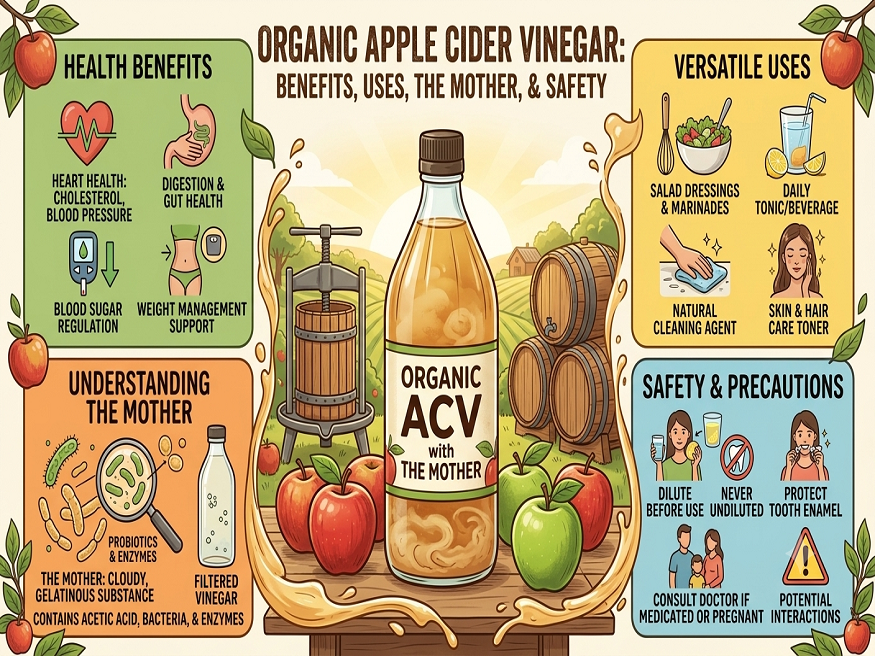
Walk into almost any grocery store in the US & you’ll probably find organic apple cider vinegar (ACV) sitting somewhere between the cooking oils, salad dressings, & natural-food products. It has become far more than a pantry ingredient. People add it to drinks, drizzle it into dressings, use it in marinades, and, in some cases, take a small amount every morning because they’ve heard it might help with weight, blood sugar, digestion, or skin.
Then there is the whole world of apple cider vinegar with the mother.
That cloudy-looking bottle, the sediment at the bottom, the words “raw” & “unfiltered”—all of it can make a fairly simple food product seem much more mysterious than it really is.
And this is where things get a little complicated.
Apple cider vinegar has been studied for several possible health effects, including blood glucose, appetite, insulin sensitivity, cholesterol, & body weight. Some findings are interesting. Others are preliminary. A number of popular claims, however, have travelled much further than the research itself.
For example, apple cider vinegar is often marketed as a natural weight-loss aid. Yet Mayo Clinic notes that there isn’t solid evidence showing that ACV produces meaningful long-term weight loss.
So, if you’re considering buying a bottle, drinking it in the morning, using it in recipes, or trying one of the many ACV trends circulating online, what actually matters?
Let’s take a closer look.
What Is Apple Cider Vinegar?
Apple cider vinegar is made by fermenting an apple-based liquid.
The process happens in two broad stages. First, yeast converts the sugars in the apple liquid into alcohol. Then bacteria convert that alcohol into acetic acid.
That second step is what gives vinegar its familiar sharp taste & smell.
The FDA describes cider vinegar & apple vinegar as products made through alcoholic fermentation followed by acetous fermentation of apple juice. Natural vinegars generally contain at least 4 grams of acetic acid per 100 milliliters.
So, despite the name, apple cider vinegar isn’t simply apple cider that has been concentrated.
It’s a fermented food with a different chemical makeup & a much more pronounced acidity.
The acetic acid is the star of the show. Commercial apple cider vinegar commonly contains around 5% to 6% acetic acid.
In simple terms: Apple cider vinegar is fermented apple juice that has been converted into an acidic vinegar, with acetic acid responsible for much of its characteristic flavor & acidity.
Most people encounter ACV as a food rather than a medicine. It can be used in salad dressings, sauces, marinades, pickles, soups, & drinks.
How Is Apple Cider Vinegar Made?
The process sounds complicated, but the basic idea is fairly straightforward.
Apple-based liquid contains sugars. Yeast feeds on those sugars & produces alcohol.
Then another group of microorganisms gets involved. Acetic-acid bacteria convert the alcohol into acetic acid.
Once the fermentation process is complete, the vinegar can be filtered & processed or left with more of the material created during fermentation.
That choice affects how the finished vinegar looks.
A filtered product may be almost completely clear. A less-filtered product can be hazy, contain floating strands, or have sediment sitting at the bottom.
This brings us to one of the most talked-about features of ACV: the mother.
What Does “With the Mother” Mean?
If you’ve ever picked up a bottle of apple cider vinegar with the mother, you’ve probably noticed that it doesn’t look perfectly clear.
The cloudy material or stringy sediment is commonly referred to as “the mother.”
It isn’t an added powder or a special medicinal ingredient. It is associated with the fermentation process & may contain bacteria, yeast, & other fermentation-related material.
Cleveland Clinic describes the mother as material associated with the bacteria & yeasts involved in fermentation.
But here’s something worth remembering before you pay extra for a bottle simply because it says “with the mother”:
The presence of the mother does not automatically mean the vinegar will deliver greater health benefits.
There is plenty of marketing around this point, but marketing language & clinical evidence aren’t the same thing.
What is the mother in apple cider vinegar?
The “mother” is naturally occurring fermentation material that can remain in some apple cider vinegar. It may make the vinegar appear cloudy or leave strands & sediment in the bottle. Its presence does not, by itself, prove that the vinegar provides a particular medical benefit.
Organic, Raw, Unfiltered & With the Mother: What’s the Difference?
This is where shopping for ACV can become confusing.
You may see labels saying:
- Organic
- Raw
- Unfiltered
- Unpasteurized
- With the mother
- Organic raw unfiltered
- Raw organic apple cider vinegar
These terms aren’t interchangeable.
Organic generally relates to how the agricultural ingredients & product are produced under applicable organic standards.
Raw generally indicates that the vinegar hasn’t undergone certain heating or pasteurization processes.
Unfiltered means more of the naturally occurring material remains in the vinegar.
With the mother refers to fermentation-related material that may remain suspended in the vinegar.
A bottle can have one of these characteristics without necessarily having all of them.
Are Organic & Raw Apple Cider Vinegar the Same?
No.
An apple cider vinegar organic product can meet organic standards without necessarily being raw or unfiltered.
Likewise, a raw vinegar isn’t automatically organic.
If you’re specifically shopping for raw organic apple cider vinegar, check the actual label. Don’t rely on a cloudy appearance or a picture of a rustic-looking bottle on an online store.
The label tells you considerably more than the color of the vinegar.
How Should You Choose Apple Cider Vinegar?
There’s no need to overcomplicate it.
Think about what you actually intend to do with it.
If you’re buying ACV for cooking, flavor, acidity, ingredients, & price may matter more than whether the vinegar looks cloudy.
If you want raw unfiltered apple cider vinegar, make sure those characteristics are stated on the bottle.
If you specifically want apple cider vinegar with the mother, look for that wording.
And if organic certification matters to you, look for the appropriate certification rather than assuming that a product described as “natural” is automatically organic.
It isn’t.
20 Potential Benefits & Uses of Apple Cider Vinegar
Search “20 benefits of apple cider vinegar” online & you’ll find some extraordinarily long lists.
Some will make ACV sound almost magical.
A more sensible way to look at it is to separate established culinary uses from possible physiological effects that researchers are still investigating.
Here are 20 ways ACV may be used or areas in which it has been studied:
- Making salad dressings more acidic.
- Adding flavor to marinades.
- Brightening sauces.
- Supporting pickling recipes.
- Adding acidity to soups & stews.
- Providing dietary acetic acid.
- Potentially influencing blood glucose after meals.
- Potentially affecting insulin sensitivity.
- Possibly increasing short-term feelings of fullness.
- Being investigated for possible effects on body weight.
- Supplying small amounts of naturally occurring compounds.
- Exhibiting antimicrobial activity because of its acidity.
- Replacing some richer dressings or sauces.
- Adding considerable flavor without many calories.
- Being used for certain household cleaning jobs.
- Forming the acidic base of homemade vinaigrettes.
- Adding tartness to recipes.
- Being used in some food-preservation methods.
- Serving as a fermented food ingredient.
- Remaining an area of research involving metabolic health.
Notice the wording.
These are potential uses & researched effects, not 20 guaranteed health benefits.
That’s an important distinction.
Mayo Clinic has noted that research surrounding blood sugar, cholesterol, gut health, immune function, & weight loss remains limited. More research, particularly longer-term research, is needed.
Can Apple Cider Vinegar Affect Blood Sugar?
Blood sugar is one of the areas where ACV has attracted genuine scientific interest.
Some studies suggest vinegar may influence blood glucose or insulin responses around meals. That sounds promising, but individual studies don’t automatically translate into a treatment recommendation.
Research varies in size, duration, design, & participant characteristics.
Mayo Clinic has discussed possible effects involving fasting blood glucose & insulin sensitivity while also pointing out the limitations of the available evidence.
Does apple cider vinegar lower blood sugar?
Apple cider vinegar may influence blood glucose responses in some situations, but current evidence isn’t strong enough to consider ACV a treatment for diabetes or a replacement for prescribed medication.
If you have diabetes or take medication that lowers blood glucose, talk with your healthcare professional before making regular ACV consumption part of your routine.
Can Apple Cider Vinegar Help With Weight Loss?
This is probably one of the biggest questions surrounding ACV.
The internet is full of claims about drinking apple cider vinegar before meals, taking ACV shots, or starting an apple cider vinegar morning routine to lose weight.
The evidence isn’t nearly as dramatic.
Apple cider vinegar has not been proven to cause meaningful long-term weight loss.
Mayo Clinic’s March 2025 guidance says research hasn’t proved that ACV helps people lose weight & points out that many studies have been small or otherwise limited.
That doesn’t mean every study has found absolutely nothing.
Some smaller studies have reported potentially interesting findings. But that’s different from having enough evidence to recommend ACV as a dependable weight-loss method.
If you’re trying to lose weight, ACV is better viewed as a food ingredient than a shortcut.
Does Apple Cider Vinegar Have Antimicrobial Properties?
Yes, vinegar is acidic, & that acidity gives it antimicrobial properties.
Acetic acid is largely responsible for vinegar’s acidic environment.
But there’s a significant gap between saying vinegar can inhibit certain microorganisms & saying drinking ACV prevents infections.
Those are two very different claims.
The second would require clinical evidence demonstrating that consuming ordinary apple cider vinegar actually prevents or treats infections in people.
That evidence isn’t established.
Are Apple Cider Vinegar Shots Worth Trying?
You’ve probably seen them.
A tiny glass. A tablespoon or so of ACV. Maybe some water. Then down it goes.
Apple cider vinegar shots became popular because they’re convenient & fit neatly into the modern “one small wellness habit every morning” routine.
The trouble is that vinegar is acidic.
Swallowing it undiluted puts that concentrated acidity directly in contact with the mouth & throat. Repeated exposure can also be hard on tooth enamel.
Mayo Clinic warns that frequent or excessive consumption may irritate the throat & that acidic drinks can contribute to enamel erosion.
There isn’t a medical requirement to take ACV as a shot.
If you want to consume it, using it in food or diluting it makes more sense than treating a concentrated shot as some kind of daily health ritual.
How Can You Use ACV More Carefully?
If you drink it, don’t treat it like a shot of liquor.
Dilute it with water or add it to food.
Using ACV in a vinaigrette is one of the easiest options. So is adding a small amount to a recipe that already calls for an acidic ingredient.
After drinking an acidic beverage, rinsing your mouth with plain water can help clear away some of the acid.
And there’s really no prize for drinking more.
Should You Drink Water With Apple Cider Vinegar in the Morning?
The water with apple cider vinegar in the morning trend has become incredibly popular.
The appeal is obvious. It takes less than a minute, costs very little, & feels like a simple way to start the day with a “healthy” habit.
But there’s no strong evidence showing that ACV has a special effect simply because you drink it first thing in the morning.
You don’t need to consume it immediately after waking up.
If you enjoy diluted ACV & it agrees with you, there’s nothing inherently special about the clock.
You can also simply use it in food.
What About Apple Cider Vinegar in Hot Water?
Searches for benefits of apple cider vinegar in hot water often suggest that warm water somehow unlocks additional benefits.
There isn’t good evidence for that idea.
Warm water may make the drink more pleasant, especially in colder weather, but it doesn’t turn ACV into a medically established treatment.
The important factors remain the amount consumed & the acidity of the vinegar.
Is Apple Cider & Apple Cider Vinegar the Same?
No, & this confusion is surprisingly common.
Apple cider & apple cider vinegar are different products.
Apple cider is an apple-based beverage.
Apple cider vinegar is made by fermenting an apple-based liquid until alcohol is converted into acetic acid.
FDA guidance describes cider vinegar & apple vinegar as vinegar produced through alcoholic & acetous fermentation of apple juice.
So if you’re wondering:
- Is apple vinegar & cider vinegar the same?
- Is apple vinegar the same as cider vinegar?
- Is apple cider & apple cider vinegar the same?
The names may sound similar, but the products aren’t interchangeable.
Apple cider is a beverage. Apple cider vinegar is a fermented vinegar.
Can You Use Apple Cider Vinegar to Clean?
Yes, but don’t expect it to replace every cleaning product in your house.
Vinegar’s acidity makes it useful for certain everyday cleaning jobs, such as dealing with some mineral deposits & odors.
However, apple cider vinegar isn’t a universal disinfectant.
If you’re choosing vinegar specifically for household cleaning, white distilled vinegar is often a more practical option. It’s clear, inexpensive, & doesn’t leave the same apple scent or color.
More importantly, don’t substitute vinegar for an EPA-registered disinfectant when proper disinfection is necessary.
And there’s one warning you should never ignore:
Never mix vinegar with chlorine bleach.
Acidic vinegar can react with bleach & release hazardous chlorine gas.
Apple Cider Vinegar for Household Uses
Vinegar can be useful around the home, but the surface matters.
Acidic products aren’t appropriate for every countertop, appliance, fixture, or floor. Some natural stones, for example, can be damaged by acids.
Check the manufacturer’s cleaning instructions before reaching for vinegar.
So, when someone asks “can I use apple cider vinegar to clean?”, the answer is: sometimes. It depends on what you’re cleaning & what you’re trying to remove.
Apple Cider Vinegar for Skin: Does It Actually Work?
Searches for apple cider vinegar skin cover a surprisingly wide range of claims.
Some people drink ACV because they believe it will improve their complexion. Others apply it directly to their skin, particularly when dealing with acne.
Neither approach deserves to be treated as a miracle cure.
Cleveland Clinic notes that ACV is sometimes promoted for acne because of antibacterial & antifungal properties, but there isn’t sufficient evidence establishing it as a proven acne treatment.
There’s also a practical concern.
Vinegar is acidic, & concentrated ACV can irritate skin or cause burns.
Is apple cider vinegar good for skin?
There isn’t strong clinical evidence showing that drinking apple cider vinegar dramatically improves skin. Applying concentrated ACV directly to the skin can cause irritation & burns, so it shouldn’t be treated as a routine DIY skincare product.
Should You Put ACV Directly on Your Skin?
Be especially cautious with undiluted ACV.
The skin has a protective barrier that helps keep moisture in & irritants out. Applying a strongly acidic kitchen ingredient directly to that barrier isn’t necessarily harmless.
If you’re dealing with acne, eczema, persistent redness, a rash, or another skin condition, there are established dermatological treatments designed for those problems.
Kitchen vinegar isn’t a substitute for them.
What About Apple Cider Vinegar Baths?
Apple cider vinegar bath benefits are frequently discussed online.
Some people add diluted ACV to bath water because they believe it can soothe irritated skin or change the skin’s surface environment.
The evidence for routine ACV baths, however, is limited.
And more is not better.
Highly concentrated vinegar can irritate or burn the skin. It shouldn’t be poured onto broken skin, open wounds or severely irritated areas.
If you have eczema, a persistent rash, or unexplained skin irritation, speak with an appropriate healthcare professional instead of relying on an ACV bath as treatment.
What Is Bragg’s Vinegar Used For?
Bragg’s vinegar is a well-known brand of apple cider vinegar.
People use it in much the same way they use other ACV products: salad dressings, marinades, recipes, drinks and other culinary applications.
If you’re searching “what is Bragg’s vinegar used for,” check the exact product you are considering. Bragg sells different products, & ingredients, serving information, & other details can vary.
Don’t assume that a recognizable brand name changes the basic considerations surrounding ACV.
It’s still acidic vinegar.
The same issues involving concentrated consumption, tooth enamel, medication interactions, & unsupported health claims still deserve attention.
How I Use Apple Cider Vinegar in Everyday Cooking
Honestly, cooking is probably the least complicated way to use ACV.
You can whisk it into olive oil with mustard, herbs, salt and pepper for a quick vinaigrette.
A splash can sharpen a marinade. It can brighten a slaw. It can cut through the richness of a sauce. It can also bring some welcome acidity to soups & stews.
And if you do not enjoy drinking vinegar, you do not have to.
There’s nothing inherently healthier about forcing down an ACV shot when you could simply use the ingredient in food.
Mayo Clinic includes vinaigrettes, pickling, soups, & beverages among common ways to use apple cider vinegar.
Apple Cider Vinegar Safety: What US Consumers Should Know
The biggest thing to remember about ACV is simple:
It’s acidic.
That matters more than many wellness articles make it sound.
Frequent consumption of concentrated vinegar can irritate the throat & contribute to dental enamel erosion. Mayo Clinic also notes potential interactions involving certain medications, including some diuretics & insulin.
ACV may also contribute to low potassium in certain circumstances.
Harvard Health likewise recommends diluting vinegar & highlights concerns involving tooth enamel & potassium.
If you take medication for diabetes, blood pressure, or another condition, ask your healthcare professional whether regular ACV consumption is appropriate for you.
The same caution applies to ACV supplements.
A capsule, gummy, or tablet may look more harmless than liquid vinegar, but the format alone doesn’t guarantee safety.
Is Apple Cider Vinegar FDA Approved as a Treatment?
No. Apple cider vinegar is not an FDA approved treatment for diseases.
This distinction matters because health claims online can become exaggerated very quickly.
You may encounter articles suggesting that ACV treats diabetes, high cholesterol, infections, cancer, or other illnesses.
Those claims go considerably beyond what the available evidence supports.
For a health article, it is more accurate to describe ACV as a food ingredient that has been studied for possible physiological effects.
That wording may sound less exciting.
It’s also much closer to what the evidence actually tells us.
Organic Raw Unfiltered Apple Cider Vinegar: What Should You Look For?
If you’re shopping specifically for organic raw unfiltered apple cider vinegar, spend a few seconds reading the label.
Don’t buy a bottle simply because it looks rustic or cloudy.
Look for:
- Organic certification if certified organic production matters to you.
- Raw if you specifically want raw vinegar.
- Unfiltered if you prefer vinegar that retains more fermentation material.
- With the mother if that feature matters to you.
- A straightforward ingredient list.
- Acidity information where available.
- Storage instructions.
And remember: cloudiness is not a health score.
A clear bottle isn’t automatically worse. A cloudy bottle isn’t automatically better.
Choose according to what you’re buying it for.
Frequently Asked Questions
Is apple cider vinegar with the mother better?
There is not enough evidence to say that ACV with the mother is universally better for health than filtered ACV.
The mother is associated with fermentation, but its presence does not prove that the vinegar will produce a particular medical benefit.
What are the benefits of apple cider vinegar shots?
Vinegar has been studied for possible effects on post-meal blood glucose & other metabolic measures. However, the evidence remains limited.
Taking ACV as a concentrated shot also means exposing your mouth, throat, & teeth to more acidity at once.
If you choose to consume it, dilution or using it with food is a more cautious approach.
Can apple cider vinegar help you lose weight?
Current evidence does not establish ACV as a dependable long-term weight-loss method.
Mayo Clinic has stated that research hasn’t proved apple cider vinegar causes meaningful weight loss.
Can I drink apple cider vinegar every day?
Some people consume small amounts regularly, but there’s no nutritional requirement to drink ACV every day.
If you choose to use it, avoid consuming it undiluted & consider adding it to food or diluting it.
If you take medication or have an ongoing health condition, speak with a healthcare professional before making regular ACV consumption a habit.
Is raw unfiltered apple cider vinegar safe?
Commercial apple cider vinegar can generally be consumed in modest quantities, but raw and unfiltered products should still be used and stored according to their labels.
For everyday consumption, acidity is one of the main concerns, especially when vinegar is taken in concentrated form.
If you have a medical condition or take medication that could interact with ACV, individualized medical advice is more appropriate than relying on general internet guidance.
Conclusion
Organic apple cider vinegar is neither a miracle potion nor merely another trendy wellness product.
It’s a fermented food ingredient that has been used in cooking for a long time & has also attracted scientific interest because of its acetic acid content.
The terminology can be confusing at first. Organic, raw, unfiltered and with the mother all describe different characteristics of a product. Understanding those labels is far more useful than assuming a cloudy bottle must somehow be healthier.
Researchers have explored ACV in connection with blood glucose, insulin sensitivity, appetite, cholesterol, and weight. Some results are worth watching, but the existing evidence isn’t strong enough to turn ACV into a cure-all.
For everyday use, cooking is arguably the simplest route.
Put it in a vinaigrette. Add it to a marinade. Use it in a pickle recipe. Stir a little into a sauce where you need extra acidity.
You don’t have to drink it.
If you prefer water with apple cider vinegar in the morning, dilute it rather than swallowing concentrated vinegar. & don’t assume that taking an ACV shot is somehow essential to a healthy routine.
The same common sense approach applies to skincare.
Apple cider vinegar skin treatments and ACV baths are not established replacements for evidence based dermatological care, & concentrated vinegar can cause irritation or burns.
In the end, ACV is best understood for what it actually is: a fermented food ingredient with some interesting areas of ongoing research-not a detox cure, miracle weight loss drink, or replacement for medical treatment.
Medical & Editorial Note
This article is intended for general educational purposes & isn’t a substitute for individualized medical advice.
If you take prescription medication, have diabetes, kidney or electrolyte concerns, or have another ongoing health condition, speak with a qualified healthcare professional before making regular apple cider vinegar consumption part of your routine.
For publication, consider adding the author’s name, author bio, publication date, last-reviewed date, & a qualified medical or nutrition reviewer where appropriate. Health-related statements should also be supported with links to the underlying medical or scientific literature.
Sources
- Cleveland Clinic – Apple cider vinegar composition, uses, potential effects, & safety.
- Mayo Clinic – Apple cider vinegar uses, possible benefits, & safety considerations.
- Mayo Clinic – Research concerning apple cider vinegar & weight loss.
- FDA – Definitions & guidance concerning vinegar.
- FDA – Requirements surrounding health claims for foods & supplements.
- Harvard Health – Apple cider vinegar, acidity, tooth enamel, weight, & medication considerations.
- Cleveland Clinic – Apple cider vinegar & skin/acne claims.
